Racks & Wall Storage · identification & value
Vintage Coat Hook
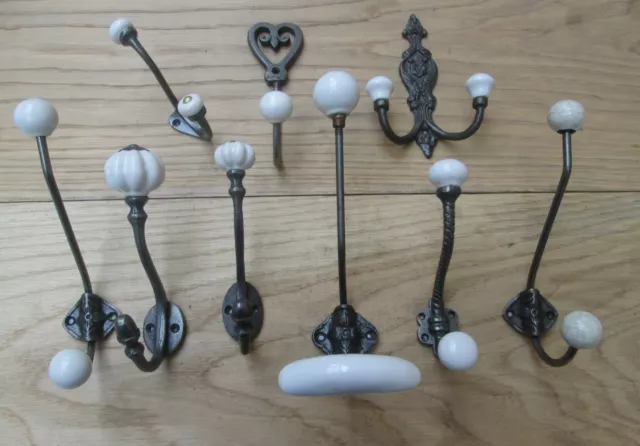
Every French school corridor and café once had a row of patères at shoulder height: a cast hook with a ball end for the hat and a lower arm for the coat. When those buildings were refitted, the hooks came off in batches and went to the brocante by the crate.
1860–1940
Verified market data (US$)
$66 – $330 – $2,475
lowest · median · highest observed
French dealers asking on Proantic: €60–2 250 (median €300, 37 listings). (Proantic prices converted to USD at 1 EUR = $1.10.)
Expert tip
Look at the back plate: an old cast-iron hook has a grainy sand-cast back with screw holes rounded by decades of screwdrivers, while 'antique-style' copies have smooth flat backs and rust that wipes off on a damp finger.
History
- Cast-iron hall hooks were mass-produced from the mid-19th century as foundries turned to decorative catalogue wares.
- Art Nouveau brought cast brass and bronze patères with whiplash curves around 1900; Art Deco (1920s–30s) favoured nickel or chrome with Bakelite or glass balls.
Where it comes from
French ornamental cast iron from the Haute-Marne foundries; brass and bronze patères from Paris hardware houses (quincaillerie); English Victorian cast-iron hall hooks; Art Deco chromed hooks from French and German factories.
Details to look at
- The double hook form: upper hat arm with a ball or acorn tip, lower coat arm.
- Back plate shape and number of screw holes.
- Finish: original paint, nickel plating or bronze patina, and whether balls are porcelain, glass or Bakelite.
The market: most wanted
- Art Nouveau gilt-bronze or brass patères with floral or whiplash designs.
- Art Deco chromed hooks with coloured Bakelite or black glass balls.
- Complete rows of school or café hooks still on their original oak rail.
Authenticity: period piece or reproduction?
- A magnet will not stick to solid brass or bronze; it grabs plated steel and cast iron at once.
- Period casting shows small pits and mould lines filed by hand; modern copies have sharp crisp seams or none.
- Original screws are slotted with tapered shanks; matching slotted screws still in place are a good sign.
- Warning signs: painted-on 'rust' over a fresh red primer, identical hooks sold by the hundred, and 'cast iron' pieces that weigh almost nothing.
Where to buy
- Regional brocantes and vide-greniers, Leboncoin, and architectural salvage yards in France for school and café hooks; Saint-Ouen for Art Nouveau bronze patères.
- In the US and UK, Etsy and eBay for single hooks and sets, salvage dealers for Victorian hall hooks, and Chairish for Art Deco and Art Nouveau examples.
Buyer's checklist
- Magnet test
- Back plate wear
- Number of matching hooks
- Screw type
Facts
- Typical size
- H 10–25 cm · projection 8–20 cm
- Weight
- 0.1–0.8 kg each
- Period
- 1860–1940
- Materials
- Cast iron, brass, bronze, nickel or chrome plate, porcelain, glass, Bakelite
- US search interest
- 240 searches a month
Collector interest
Coat hook draws 240 monthly US searches, split into 8 keyword variants.
Style words in the queries: art deco (60).
The materials buyers name are cast iron (160).