Dressers & Commodes · identification & value
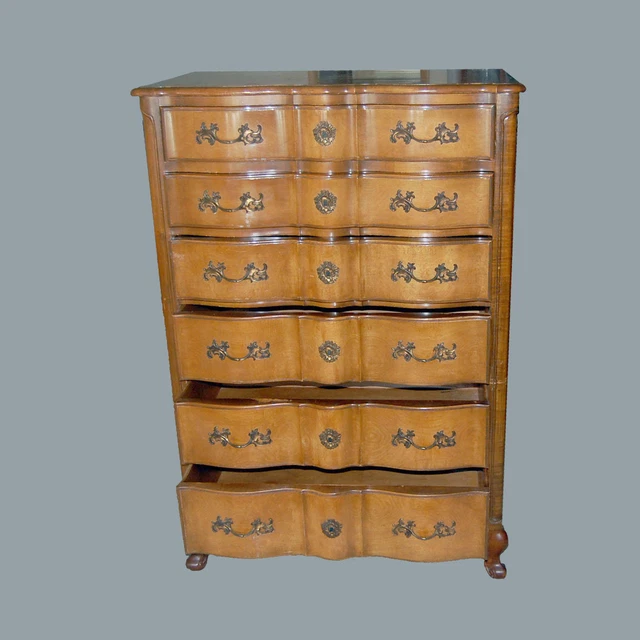
Vintage Highboy Dresser
In 18th-century Philadelphia, a merchant's bedchamber was dominated by a tall chest on legs, with cabriole legs ending in claw-and-ball feet and a broken pediment topped by carved flames. In Paris the same decades produced the semainier, a slim tall chest whose seven drawers were said to hold one day's linen each.
1700–1970
Typical asking price on live listings
about $280
Median of current eBay asking prices (via PicClick); listings run from $2.5 to $3,495. Asking prices are not sold prices.
Expert tip
Pull out a top-case drawer and a bottom-case drawer and compare them: on a genuine two-part highboy the secondary wood, the dovetail spacing and the oxidation match; a mismatch means a 'married' piece made from two different chests.
History
- American highboys were made from about 1700 to 1790 in William and Mary, Queen Anne and Chippendale styles, with Philadelphia and Newport as leading centres.
- The French semainier dates from the 18th century; in the 20th century 'highboy' came to mean any tall chest of drawers, including 1930s Art Deco and 1960s French Provincial versions by American makers.
Where it comes from
Not a French form: the highboy is American (Boston, Newport, Philadelphia, about 1700–1790). France's tall chests are the semainier (seven drawers) and the chiffonnier, made in Paris and the provinces.
Details to look at
- Legs and feet: trumpet legs (William and Mary), cabriole legs with pad or claw-and-ball feet.
- Top: flat cornice or broken-arch bonnet with flame finials and a carved shell drawer.
- Hardware: batwing or willow brasses, or ring pulls on semainiers.
The market: most wanted
- Philadelphia and Newport Chippendale highboys with carved shells and claw-and-ball feet.
- Louis XVI semainiers in mahogany or marquetry with marble tops.
- 1930s Art Deco highboys with waterfall veneers and 1960s French Provincial pieces in original finish.
Authenticity: period piece or reproduction?
- Secondary woods (white pine, tulip poplar) show grey oxidation inside and fresh colour only where repaired.
- Legs on a Queen Anne highboy are tenoned into the case, and their knees match in carving and colour.
- Original brasses leave a single set of holes on each drawer front.
- Warning signs: married upper and lower cases, replaced legs, carving added to a plain piece, and a top case that overhangs the base unevenly.
Where to buy
- Saint-Ouen and Proantic for semainiers; Leboncoin and Selency for 20th-century tall chests.
- In the US, Americana auctions, 1stDibs and Chairish for highboys; eBay, estate sales and Facebook Marketplace for Art Deco and French Provincial tall chests.
Buyer's checklist
- Cases match
- Legs original
- Single brass holes
- Carving original
Facts
- Typical size
- H 140–230 cm · W 80–110 cm · D 45–60 cm
- Weight
- 50–120 kg
- Period
- 1700–1970
- Materials
- Mahogany, walnut, maple, cherry, pine and poplar secondary woods, veneers
- US search interest
- 300 searches a month
Collector interest
US shoppers type 300 searches a month about highboy dresser, spread over 12 keyword variants.
The styles people attach to it most are art deco (10), french provincial (10).
Searches by country of origin: french (10).