Chairs · identification & value
King Louis Chairs (Louis XV & XVI)
At Versailles, who could sit, and on what, was a matter of rank: the king sat in an armchair, princes on stools. In the reigns of Louis XV and Louis XVI, the Paris menuisiers turned the armchair into a light, comfortable piece, with cabriole legs and then fluted straight legs, and the shapes they created still bear the kings' names.
1700–1950
Typical asking price on live listings
about $190
Median of current eBay asking prices (via PicClick); listings run from $2.5 to $16,500. Asking prices are not sold prices.
Expert tip
Look for an estampille, the maker's name struck with an iron stamp into the seat rail: Paris guild rules required it from 1743 to 1791, so a stamp such as 'I.B. TILLIARD' or 'G IACOB' points to a period Paris chair (check it against reference books).
History
- Louis XIV (1643–1715) chairs are high-backed and massive, with H-stretchers and carved scrolls.
- Louis XV (1715–1774) chairs have cabriole legs, curves, and no stretchers; the bergère and the cabriolet (concave back) appear.
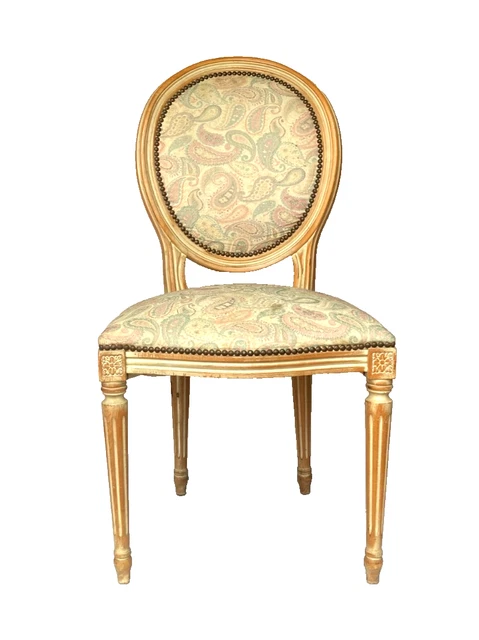
- Louis XVI (1774–1792) chairs return to straight fluted legs and oval medallion or square backs; the 'Louis Ghost' by Philippe Starck for Kartell (2002) is a modern tribute.
Where it comes from
Paris menuisiers of the Faubourg Saint-Antoine for period Louis XIV, XV and XVI seat furniture; provincial workshops (Lyon, Bordeaux, Provence) for regional versions; 19th- and 20th-century factories for the 'style Louis' copies most often sold as 'King Louis chairs'.
Details to look at
- Leg form: cabriole (XV) or fluted and tapering (XVI), and the carving at the knees.
- Back shape: flat à la reine, concave cabriolet, or oval medallion.
- Frame joints: mortise-and-tenon with wooden pegs, no screws.
The market: most wanted
- Stamped Paris chairs by known menuisiers (Tilliard, Jacob, Sené, Delanois).
- Louis XV bergères and fauteuils à la reine in original gilding or paint.
- Louis XVI medallion chairs in sets, and quality 19th-century copies by Paris firms.
Authenticity: period piece or reproduction?
- Pegged joints that stand slightly proud as wood shrinks; corner blocks glued, not screwed.
- Hand-carved detail with variations between pairs; old surfaces with layers of paint or gilding.
- Seat rails show many old tack holes from successive upholsteries.
- Warning signs: stamps on recent chairs, staples and foam with no tack holes, machine-carved identical details, and 'distressed' painting.
Where to buy
- In France: Drouot, Proantic and Saint-Ouen for stamped and period chairs; Leboncoin and brocantes for 19th-century style Louis chairs.
- In the US and UK: 1stDibs and Chairish for period and good copies; eBay and Etsy for 20th-century reproductions.
Buyer's checklist
- Estampille
- Pegged joints
- Tack holes
- Carving quality
Facts
- Typical size
- H 85–110 cm · W 55–70 cm · seat H 40–46 cm
- Weight
- 6–15 kg
- Period
- 1700–1950
- Materials
- Beech, walnut, oak, gilding, paint, silk, damask, horsehair
- US search interest
- 350 searches a month
Collector interest
King chair draws 350 monthly US searches, split into 10 keyword variants.
By style, searches lean to louis xvi (20), louis xv (10).
Related in Chairs
- Vintage Dining Chair
- Vintage Accent Chair
- Antique Rocking Chair
- Antique Garden Chair
- Vintage Office Chair
- Antique Arm Chair
- Folding Chair
- Vintage Bistro Chair
Go deeper: research notes
The Antique French Chairs: An Identification Guide gathers 11 sourced object studies, including: