Chairs · identification & value
Antique Rocking Chair
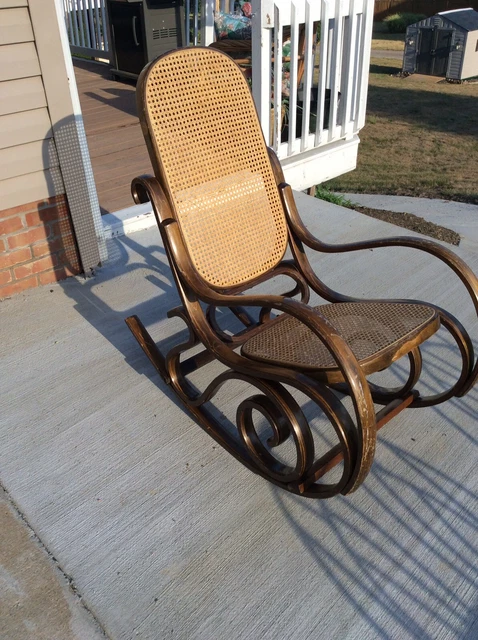
In the 1850s Michael Thonet perfected the steaming and bending of beech into curves, and his firm turned the rocking chair into a light, flowing object of loops and scrolls. The bentwood rocker became a fixture of verandas and bourgeois drawing rooms across Europe, including France. In America, the rocking chair had already become a household staple in maple and pine.
1860–1940
Guide price (US$)
$80 – $250 – $1,200
low · typical · high, dealer level
Price tip: under $80 is a bargain worth checking twice; above $1,200, ask for provenance or a maker's mark.
Verified market data (US$)
$220 – $935 – $14,080
lowest · median · highest observed
French dealers asking on Proantic: €200–12 800 (median €850, 59 listings). (Proantic prices converted to USD at 1 EUR = $1.10.)
On eBay (via PicClick), 93 listings for “antique french rocking chair” median asking price $245; median 4 watchers per listing.
Expert tip
Turn the chair over and look under the seat ring for a paper label, branded stamp or impressed mark of Thonet, Kohn or Fischel; a labelled bentwood rocker is worth much more than an anonymous one.
History
- Thonet's bentwood rocker was introduced in the 1860s and produced in large numbers in the late 19th century.
- Competitors Kohn and Fischel made similar rockers and are marked under the seat.
- Windsor and Boston rocking chairs were made in England and America from the 18th and 19th centuries.
Where it comes from
No strong French regional tradition: the bentwood rockers found in France were mostly made by Thonet and its competitors (Kohn, Fischel) in Austria-Hungary; the Windsor and Boston rockers are English and American. French country rockers in cane and beech exist but are rarer.
What sets the price
Maker, cane condition, style.
Details to look at
- Maker's label or stamp under the seat.
- Cane seat and back: original hand-woven cane or later machine cane.
- The curves and joints of the bentwood frame.
The market: most wanted
- Labelled Thonet rockers, especially early models.
- Children's bentwood rockers with original cane.
- Fine American and English rockers in original finish.
Authenticity: period piece or reproduction?
- Original Thonet pieces carry stamps or labels and show worn finish.
- Hand-caned seats have cane threaded through individual holes; machine cane is pressed into a groove.
- Old screws and fittings are slotted and worn.
- Warning signs: new cane, stripped and lacquered frames, and modern copies with no marks.
Where to buy
- In France, regional brocantes, Leboncoin and Selency for bentwood rockers; Saint-Ouen for labelled Thonet pieces.
- In the US and UK, Etsy, eBay, Chairish and local antique shops. The guide range is $80–1,200.
Buyer's checklist
- Label
- Cane state
- Joints tight
- Rockers not cracked
Facts
- Typical size
- H 90–110 cm · L 90–120 cm · W 50–60 cm
- Weight
- 6–12 kg
- Period
- 1860–1940
- Materials
- Beech bentwood, cane, maple, oak, pine
- US search interest
- 6,500 searches a month
Collector interest
US shoppers type 6,500 searches a month about rocking chair, spread over 181 keyword variants.
The styles people attach to it most are victorian (80), farmhouse (80), art deco (60), retro (40).
Material searches favour wicker (280), oak (120), rattan (70), metal (40).
Related in Chairs
- Vintage Dining Chair
- Vintage Accent Chair
- Antique Garden Chair
- Vintage Office Chair
- Antique Arm Chair
- Folding Chair
- Vintage Bistro Chair
- Antique Patio Chair
Go deeper: research notes
The Antique French Chairs: An Identification Guide gathers 11 sourced object studies, including: