Chairs · identification & value
Vintage Bentwood Chair
In 1859, Michael Thonet's company in Vienna launched its chair No. 14: six pieces of steam-bent beech, ten screws and two nuts, packed flat and shipped by the thousand. It became the café chair of Paris and of the world, and tens of millions were made, many in factories in the Moravian forests.
1860–1970
Verified market data (US$)
$154 – $770 – $3,850
lowest · median · highest observed
French dealers asking on Proantic: €140–3 500 (median €700, 18 listings). (Proantic prices converted to USD at 1 EUR = $1.10.)
Expert tip
Turn the chair over and look under the seat ring: genuine Thonet, Kohn, Fischel or Baumann chairs usually carry a burnt-in or paper label, and Thonet stamps changed over the decades, which helps date the chair.
History
- Michael Thonet developed bent solid-wood furniture in Vienna from the 1840s; the No. 14 chair was launched in 1859 and sold in vast numbers.
- After Thonet's patent expired in 1869, rivals such as J. & J. Kohn and Fischel produced bentwood; Baumann made bentwood chairs in France from the early 20th century.
Where it comes from
Vienna and Moravia for Thonet and its rivals (Jacob & Josef Kohn, Fischel, Mundus); in France, the Baumann factories of Franche-Comté and the bistro trade of Paris, which bought Austrian and French bentwood by the thousand.
Details to look at
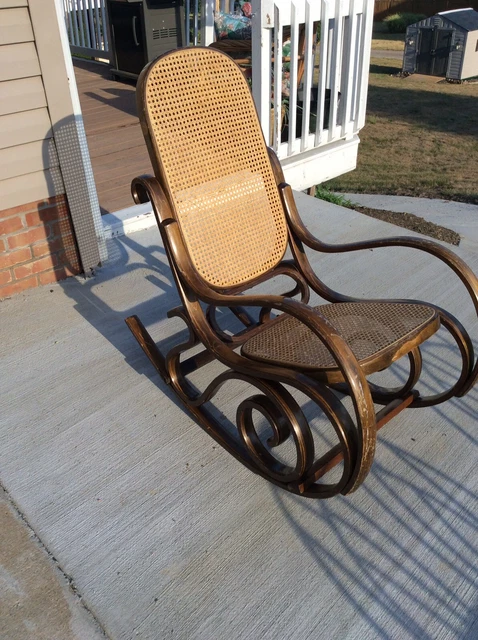
- The back: a single hoop (No. 14), a hoop with an inner loop, a double hoop or the elaborate scrolls of salon models.
- The seat: hand-woven cane, pressed plywood with an embossed pattern, or solid wood, and the bent seat ring beneath.
- The leg ring and fixings: slotted screws and bolts, with legs bolted into the seat ring.
The market: most wanted
- Early Thonet No. 14 and No. 18 chairs with legible 19th-century labels or stamps.
- Bentwood designs linked to Viennese architects such as Adolf Loos and Josef Hoffmann, made by Thonet or J. & J. Kohn.
- Matched sets of French Baumann bistro chairs in original finish, and bentwood rocking chairs from the major Viennese makers.
Authenticity: period piece or reproduction?
- Look for a paper label, burnt-in brand or stamp under the seat ring; Thonet, Kohn and Fischel marks each changed over time and can be dated with references.
- Bent solid beech shows continuous grain running round the curves; laminated or sawn curves show cut grain or layers.
- Old screws are slotted and slightly rusted in their holes; seat rings show compression marks from tightening over the years.
- Warning signs: recent reproductions with Phillips or hex bolts, fresh stain over cracked bends and plastic 'cane' seats.
Where to buy
- In France: Puces de Saint-Ouen, Leboncoin, Selency, regional brocantes and café or bistro clearances for sets.
- In the US and UK: Chairish, 1stDibs, eBay and Etsy; restaurant-fitting dealers for multiples.
Buyer's checklist
- Labels
- Joints tight
- Seat condition
- Cracks at bends
Facts
- Typical size
- H 85–90 cm · seat H 45–47 cm · W 40–45 cm
- Weight
- 3–5 kg
- Period
- 1860–1970
- Materials
- Steam-bent beech, cane, pressed plywood, screws
- US search interest
- 640 searches a month
Collector interest
US shoppers type 640 searches a month about bentwood chair, spread over 11 keyword variants.
Searcher intent: 8% want to buy.
Related in Chairs
- Vintage Dining Chair
- Vintage Accent Chair
- Antique Rocking Chair
- Antique Garden Chair
- Vintage Office Chair
- Antique Arm Chair
- Folding Chair
- Vintage Bistro Chair
Go deeper: research notes
The Antique French Chairs: An Identification Guide gathers 11 sourced object studies, including: