Tapestry & Needlework · identification & value
Antique Wall Hanging
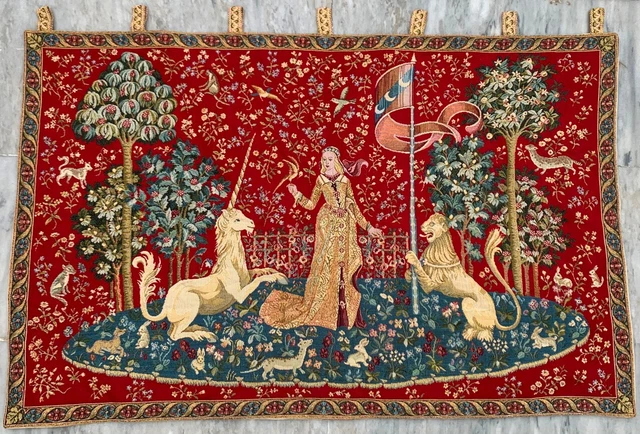
In 17th-century France, tapestries were the warmest and grandest way to dress a stone wall, and the workshops of Aubusson wove 'verdures', forest scenes of leaves and birds in greens and blues, for châteaux and manor houses. In the 1940s Jean Lurçat brought the old looms back to life with bold modern designs.
1650–1970
Typical asking price on live listings
about $199
Median of current eBay asking prices (via PicClick); listings run from $9.99 to $32,465. Asking prices are not sold prices.
Expert tip
Turn back a corner: a hand-woven tapestry shows the design on the back too, with knotted thread ends, small slits and hand-stitched joins, while a Jacquard machine weave shows long floats of thread and a reversed, uniform pattern.
History
- The Gobelins became the royal tapestry manufacture under Colbert in 1662 and Beauvais was founded in 1664; Aubusson and Felletin workshops supplied a wider market and were granted the title of royal manufacture in the 17th century.
- Jean Lurçat led the revival of Aubusson tapestry from the late 1930s and 1940s, working with painters who designed cartoons for the weavers.
Where it comes from
Aubusson and Felletin in the Creuse for verdures and later Lurçat-era tapestries; Paris for the Gobelins royal manufacture; Beauvais for its own manufacture; northern France and Belgium for 20th-century Jacquard machine 'tapestries'.
Details to look at
- Weave: hand-woven wool and silk on a loom, or machine Jacquard in cotton and wool.
- Design: verdures, hunting scenes, pastoral scenes, or modernist compositions.
- Borders, the 'bolduc' label on the back of 20th-century Aubusson pieces, and old linings.
The market: most wanted
- 17th–18th-century Aubusson verdures in good colour.
- Lurçat-period Aubusson tapestries with signed bolducs.
- Gobelins and Beauvais pieces with documented provenance.
Authenticity: period piece or reproduction?
- Hand weaving shows slits (relais), irregular hatching and repairs in different wool.
- Natural dyes fade unevenly: blues and greens hold, yellows go first, which is why old verdures look blue.
- The bolduc on a 20th-century Aubusson piece is a cloth label signed by the artist and weaver, with title and edition.
- Warning signs: Jacquard machine weaves sold as hand-woven, printed tapestries, and modern 'Aubusson' pieces from Asia without bolducs.
Where to buy
- Drouot, Paris tapestry dealers and Catawiki for antique verdures and Lurçat pieces; Aubusson's Cité internationale de la tapisserie for reference.
- In the US and UK, specialist textile dealers, 1stDibs and Chairish; eBay mostly for machine weaves.
Buyer's checklist
- Weave method
- Colours and fading
- Bolduc or provenance
- Repairs
Facts
- Typical size
- W 100–400 cm · H 100–300 cm
- Weight
- 3–25 kg
- Period
- 1650–1970
- Materials
- Wool, silk, linen lining
- US search interest
- 120 searches a month
Collector interest
US shoppers type 120 searches a month about wall hanging, spread over 7 keyword variants.
By style, searches lean to art deco (10).
Searches by country of origin: french (50).