Home Linens · identification & value
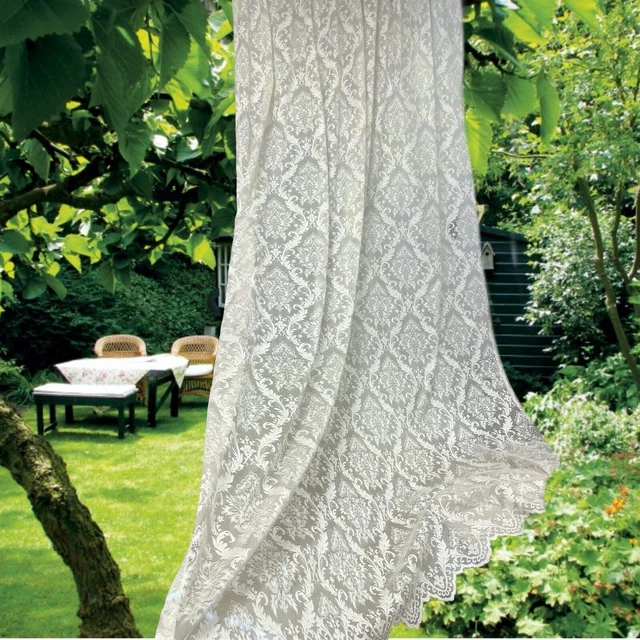
Vintage Window Curtain
In French country windows, the lower half was often hidden by a brise-bise: a short café curtain in lace, crochet or embroidered linen, hung on a thin rod so passers-by could not see in but light still poured through the top. Longer curtains came from Calais lace looms or from heavy linen sheets in the trousseau.
1880–1960
Typical asking price on live listings
about $85
Median of current eBay asking prices (via PicClick); listings run from $13 to $19,998. Asking prices are not sold prices.
Expert tip
Hold the lace up to daylight: Calais Leavers lace has a fine hexagonal tulle ground with a heavier outlining thread (gimp) around the motifs, while hand crochet shows slight differences between repeats and a chained edge.
History
- Leavers lace machines were brought to Calais from England in the early 19th century; Calais and Caudry became the centres of French machine lace.
- Brise-bise curtains were common in French homes from the late 19th century until the 1960s.
Where it comes from
Calais and Caudry (Leavers lace); the Vosges and Normandy (linen and hemp sheets later cut into curtains); Lyon (silk damask); Provence (indienne prints).
Details to look at
- Header: rod pocket, hand-sewn rings or tape.
- Lace ground and motifs; embroidered monograms on linen panels.
- Fibre: cotton, linen, hemp, silk.
The market: most wanted
- Hand-crocheted and embroidered brise-bise in pairs.
- Long Calais lace panels with original scalloped edges.
- Heavy homespun hemp panels and Lyon silk damask curtains.
Authenticity: period piece or reproduction?
- Hand embroidery shows knots and loose threads on the reverse; machine work has a regular backing stitch.
- Old linen has slubs and a soft drape after many washes.
- Pairs should match in length and pattern; mismatched panels are common.
- Warning signs: polyester lace, modern 'vintage style' brise-bise made in Asia, and hems with fresh machine stitching on 'all original' pieces.
Where to buy
- Linen fairs and brocantes in Provence, L'Isle-sur-la-Sorgue, Saint-Ouen (Marché Vernaison), Leboncoin and Selency.
- Etsy and eBay for French brise-bise and lace panels; specialist US linen dealers.
Buyer's checklist
- Fibre
- Pair matching
- Stains and holes
- Header type
Facts
- Typical size
- Brise-bise H 40–70 cm · W 60–130 cm; long panels to 260 cm
- Weight
- 0.1–1.5 kg per panel
- Period
- 1880–1960
- Materials
- Cotton lace, linen, hemp, silk
- US search interest
- 260 searches a month
Collector interest
US shoppers type 260 searches a month about window curtain, spread over 9 keyword variants.
By style, searches lean to farmhouse (160), art deco (10).
Related in Home Linens
- Vintage Quilt
- Vintage Curtain
- Vintage Pillow
- Vintage Throw Pillow
- Vintage Throw Blanket
- Vintage Blanket
- Napkin Holder
- French Linen
Go deeper: research notes
The Vintage Linen Napkins: An Identification Guide gathers 11 sourced object studies, including: