Vintage Oyster Plates · research note
Vintage oyster plates: wells, makers and condition
A vintage oyster plate is shaped or arranged to hold individual oysters, often around a separate central area. Its wells, rim, underside and marks provide different kinds of evidence. Shell decoration alone is not a complete identification. Begin by recording the form and material, then investigate the maker and condition. A useful description also distinguishes the plate's historical purpose from any proposed food use today.
Form explains use, but does not settle attribution
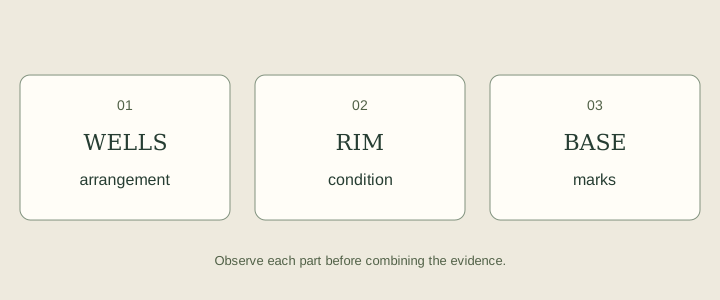
Count and describe the depressions rather than assuming every oyster plate follows one layout. Note whether the wells are shell-shaped, whether a central recess is present and how the rim is formed. A shell motif can appear on many decorative dishes; the working arrangement of the surface is more informative than ornament alone.
The Met records a Haviland & Co. oyster plate of about 1879–80 designed by Theodore Russell Davis for the Hayes service. Its naturalistic arrangement includes five open oyster wells and seaweed decoration. The service was made in Limoges for an American commission. This documented example shows why place of manufacture, designer and intended patron should be separate fields rather than collapsed into a single national label.
Read the underside as carefully as the front
Ask for a well-lit image of the full underside, followed by close-ups of marks. Transcribe words, numbers and symbols exactly; do not fill an illegible gap with the name you hope to find. A printed maker's mark, a painted decorator's mark and an impressed number may carry different information. Research the particular combination rather than treating every number as a date.
Record the foot and any unglazed areas already exposed. Photographs of these areas can help a specialist assess the body, but a buyer should not scratch the glaze to produce a sample. Keep the material description appropriately qualified. The terms porcelain, faience and majolica are not interchangeable labels for anything colourful and ceramic.
Make a condition map, not just a verdict
Inspect the rim, the borders between wells and the underside. A chip on a raised shell edge may be difficult to see in an overhead photograph. Distinguish a visible crack through the body from a network of fine lines apparently confined to glaze, and request additional views when the depth is uncertain. An image alone may not resolve whether restoration is present.
For a group, record each plate individually. Similar decoration does not ensure identical size, maker or condition. If the goal is a display, compare depth and mounting requirements as well as colour. If the goal is serving food, obtain an appropriate assessment of the material and condition rather than assuming that a historical dining object is ready for present-day use.
| Part or term | What to record | Why it matters |
|---|---|---|
| Top | Wells, centre and raised decoration | Function and design |
| Underside | Foot, marks and exposed body | Researchable manufacturing evidence |
| Edges | Chips, cracks and restoration | Condition of each individual plate |
Check your understanding
What does a place name on the base establish on its own?
Questions about vintage oyster plates
How many wells should an oyster plate have?
Do not use one well count as a universal rule. Record the actual arrangement and compare it with documented examples. The Haviland plate discussed here has five open wells, but that fact describes a specific design rather than a requirement for every oyster plate.
Does Limoges identify one manufacturer?
A place name and a maker are different kinds of information. Record the full mark and investigate the particular factory or firm associated with it. The documented Haviland example demonstrates why a more precise attribution needs the maker and design context as well as the place.
Is crazing the same as a structural crack?
The terms refer to different observations, but a photograph may not reveal the depth of a line. Describe the visible pattern and ask whether it continues through the body or appears on the reverse. Avoid using a broad condition label to conceal uncertainty.
Should a matched group have identical marks?
Compare every plate rather than imposing a rule in advance. Similar objects can have different production histories or have been assembled later. Record the marks, dimensions and decoration of each piece, then explain the evidence supporting any claim that the group is an original set.
Related object guides
Sources and scope
Museum examples are comparisons, not authentication of objects offered elsewhere. The observation record and questions are editorial aids. Research checked 16 October 2026.