Glass, Crystal & Barware · identification & value
Antique Wine Goblet
In the 19th century, the French bourgeois table was laid with a full service of crystal: water goblet, red wine, white wine and Champagne glasses, often in a pattern such as Baccarat's Harcourt. Families bought services by the dozen, and today single goblets and part-sets reappear at every brocante.
1820–1970
Typical asking price on live listings
about $70
Median of current eBay asking prices (via PicClick); listings run from $5.99 to $995. Asking prices are not sold prices.
Expert tip
Turn the goblet over and look under the foot: Baccarat pieces made from 1936 onward usually carry a small acid-etched circular mark showing a carafe, wine glass and tumbler; an earlier Baccarat glass is unmarked, so identify it by matching the cut pattern and stem to the factory's known services.
History
- Baccarat was founded in 1764 and Saint-Louis received a royal title in 1767; both produced lead crystal from the 19th century.
- Baccarat's Harcourt pattern, created in 1841, and Saint-Louis's Tommy, introduced in 1928, are among the best-known services.
Where it comes from
Lorraine and Moselle for French crystal: Baccarat (founded 1764), Saint-Louis at Saint-Louis-lès-Bitche, and Daum in Nancy; pewter goblets came from provincial pewterers across France.
Details to look at
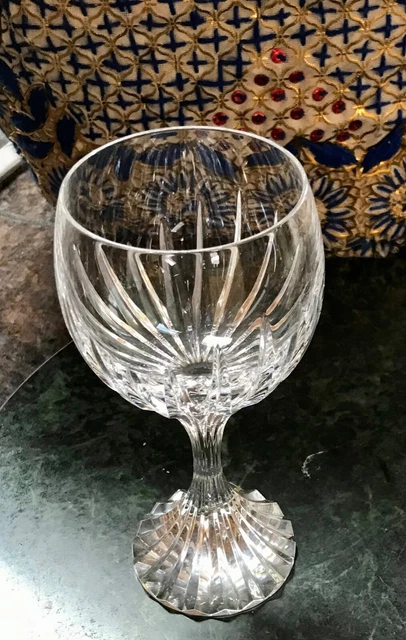
- Cutting: the broad flat flutes of Harcourt, the dense diamond and star cuts of Tommy, or simpler panel and olive cuts on provincial crystal.
- Stem: faceted, baluster or knopped stems; on Harcourt the stem and bowl are cut into flat panels, a quick way to recognise the service.
- Foot: ground and polished underside, small acid mark on later pieces, and the circle of fine scratches from years on the table.
The market: most wanted
- Baccarat Harcourt goblets and Saint-Louis Tommy services, especially full sets with the largest water goblets.
- Coloured crystal goblets with a coloured layer cut through to clear, from Baccarat, Saint-Louis and Bohemian makers.
- Pewter wine goblets and cups with the pewterer's touch-mark, from French provincial workshops.
Authenticity: period piece or reproduction?
- Lead crystal rings clearly for several seconds when flicked at the rim, and shines with a bright, slightly grey-white sparkle.
- Hand-cut facets meet in sharp, polished edges; moulded imitations have rounded edges and a slight orange-peel surface.
- Acid marks are small, crisp and slightly frosted; a mark that is engraved, too large or deep needs a second look.
- Warning signs: moulded glass sold as cut crystal, chips ground away so one rim is lower than the rest of the set, and cloudy 'sick' glass from dishwashers, which cannot be polished out.
Where to buy
- Brocantes, Leboncoin, Selency and Drouot for crystal services; Catawiki for signed part-sets; the Baccarat and Saint-Louis boutiques to match current patterns.
- In the US and UK, Replacements to complete services, plus eBay, Etsy and 1stDibs for full sets.
Buyer's checklist
- Acid mark or pattern
- Rim chips
- Cutting quality
- Clouding
Facts
- Typical size
- H 12–22 cm · rim Ø 6–9 cm
- Weight
- 150–400 g
- Period
- 1820–1970
- Materials
- Lead crystal, coloured cased crystal, pewter
- US search interest
- 370 searches a month
Collector interest
Search demand for wine goblet reaches 370 US searches a month across 9 distinct queries.
Most-searched materials: crystal (170), pewter (20).
Origins in the queries: french (140).
Related in Glass, Crystal & Barware
- Vintage Champagne Glass
- Vintage Wine Glasses
- Vintage Glassware
- Antique Champagne Flute
- Vintage Champagne Bucket
- Vintage Champagne Coupe
- Vintage Martini Glasses
- La Rochère Glasses
Go deeper: research notes
The Vintage Bar Accessories: An Identification Guide gathers 11 sourced object studies, including: