Bowls, Jars & Decanters · identification & value
Antique Pedestal Bowl
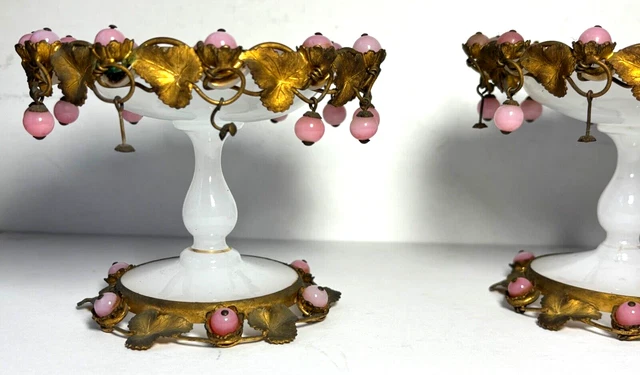
In 19th-century French homes, a coupe sur pied, a bowl on a stem, held fruit, sweets or flowers in the centre of the table. Opaline in milk white, pale blue and green was the bourgeois luxury of the Restoration and Napoleon III years, and pressed-glass versions followed for every household.
1815–1950
Typical asking price on live listings
about $119
Median of current eBay asking prices (via PicClick); listings run from $3.5 to $950. Asking prices are not sold prices.
Expert tip
Look at the base and stem: pressed glass shows faint mould seams running down the stem, while blown opaline has a polished pontil mark under the foot and no seams.
History
- French opaline glass was fashionable from the Restoration (1815–1830) to the Napoleon III period.
- Pressed glass coupes in milk white and blue were produced in Lorraine in the late 19th and early 20th centuries.
- Brass and bronze-mounted coupes were made in Paris for the luxury market.
Where it comes from
Lorraine glassworks (Portieux and Vallérysthal) for pressed milk and blue opaque glass; Baccarat and other French crystal works for opaline and cut crystal coupes; Paris bronziers for brass and gilt-bronze mounted bowls.
Details to look at
- Glass: opaline, milk glass, crystal, pressed glass.
- Stem and foot: shape, mounts, pontil.
- Decoration: gilding, painting, moulding.
The market: most wanted
- Restoration and Napoleon III opaline coupes with gilding.
- Portieux and Vallérysthal pressed glass coupes in rare colours.
- Gilt-bronze mounted crystal coupes.
Authenticity: period piece or reproduction?
- Opaline glows with a 'fire' (orange or pink) when held to strong light.
- Old pressed glass has slight imperfections and wear on the foot.
- Gilding wears softly on edges and rims.
- Warning signs: modern reproductions in milk glass, new gilding, and chipped rims ground smooth.
Where to buy
- In France, Leboncoin, Saint-Ouen, Catawiki and regional brocantes.
- In the US and UK, eBay, Etsy, Chairish and glass dealers.
Buyer's checklist
- Chips on rim and foot
- Gilding wear
- Pontil or seams
- Cracks
Facts
- Typical size
- H 10–30 cm · Ø 15–30 cm
- Weight
- 300 g–2 kg
- Period
- 1815–1950
- Materials
- Opaline, milk glass, pressed glass, crystal, brass, gilt bronze
- US search interest
- 900 searches a month
Collector interest
Pedestal bowl draws 900 monthly US searches, split into 6 keyword variants.
Most-searched materials: glass (810), brass (90).
Related in Bowls, Jars & Decanters
- Antique Bowl
- Vintage Apothecary Jar
- French Jars
- Vintage Cookie Jar
- Vintage Pyrex Bowl
- Vintage Decanter
- Vintage Olive Jar
- Silver-Rimmed Glass Bowl
Go deeper: research notes
The Antique Apothecary Jars: An Identification Guide gathers 11 sourced object studies, including:
- An apothecary bottle marked M: reading an initial without inventing a medicine
- Pharmacy jars designed to fit closely on a shelf
- The chevrette: a spouted vessel for liquid medicines
See also: Antique Olive Jars, Antique Demijohns.