Bowls, Jars & Decanters · identification & value
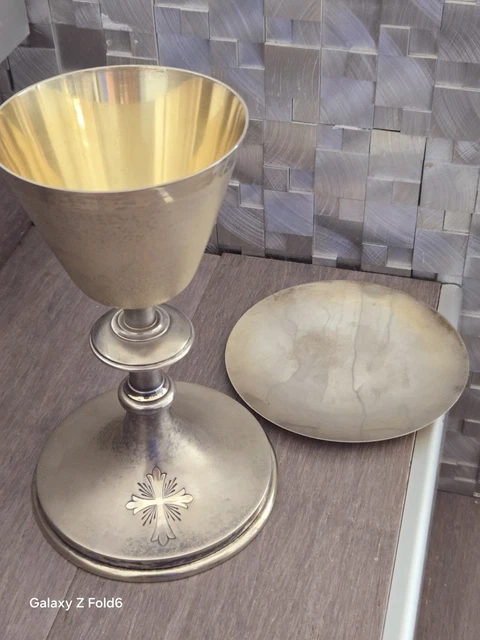
Antique Chalice
After the French Revolution emptied church treasuries, the 19th century had to refurnish thousands of parishes. Lyon and Paris workshops answered with Gothic Revival and Romanesque Revival chalices, while poorer country churches made do with pewter and gilt copper. When parishes merged in the 20th century, many of these vessels reached the antiques trade.
1820–1960
Typical asking price on live listings
about $586
Median of current eBay asking prices (via PicClick); listings run from $9.99 to $16,900. Asking prices are not sold prices.
Expert tip
Look inside the cup: a chalice intended for Mass was gilded inside the bowl even when made of copper or brass; an ungilded interior points to a decorative goblet sold as a chalice.
History
- Liturgical goldsmithing flourished in Paris and Lyon from the 1830s to 1914, with Gothic Revival forms favoured after the 1850s.
- French silver chalices carry the Minerva head mark (1838 onward) and a maker's lozenge; pewter and copper examples are usually unmarked or bear a supplier's name.
Where it comes from
Paris and Lyon liturgical goldsmiths (Poussielgue-Rusand in Paris, Armand-Calliat in Lyon) for 19th-century silver and gilt chalices; provincial pewterers for country pewter chalices; copper and brass chalices from church-supply firms.
Details to look at
- The three parts: foot, node (knop) and cup, often screwed together.
- Decoration: engraving, enamel plaques, repoussé or cast ornament.
- Marks under the foot and on the cup rim: Minerva head, maker's lozenge.
The market: most wanted
- Signed Poussielgue-Rusand and Armand-Calliat chalices with enamel.
- 18th-century silver chalices with early Paris marks.
- Complete sets with paten and fitted case.
Authenticity: period piece or reproduction?
- Silver chalices have the Minerva head on cup and foot; silver-plated ones on copper show pink metal at wear points.
- Pewter feels soft and grey and dents easily; copper and brass take a gold-toned patina.
- The paten (small plate) and fitted case add value when original.
- Warning signs: modern cast 'medieval' chalices in resin or lightweight brass, artificial verdigris and new gilding over old wear.
Where to buy
- Saint-Ouen, regional brocantes and Leboncoin for religious objects; Drouot sales of church silver.
- In the US and UK, eBay and Etsy for copper and pewter chalices; 1stDibs for signed French silver pieces.
Buyer's checklist
- Gilt cup interior
- Hallmarks
- Parts complete
- Paten included
Facts
- Typical size
- H 15–30 cm · cup Ø 8–12 cm
- Weight
- 200–900 g
- Period
- 1820–1960
- Materials
- Silver, silver gilt, gilt copper, brass, pewter, enamel
- US search interest
- 150 searches a month
Collector interest
US shoppers type 150 searches a month about chalice, spread over 3 keyword variants.
Most-searched materials: copper (80), pewter (70).
Related in Bowls, Jars & Decanters
- Antique Bowl
- Vintage Apothecary Jar
- French Jars
- Vintage Cookie Jar
- Vintage Pyrex Bowl
- Vintage Decanter
- Vintage Olive Jar
- Silver-Rimmed Glass Bowl
Go deeper: research notes
The Antique Apothecary Jars: An Identification Guide gathers 11 sourced object studies, including:
- An apothecary bottle marked M: reading an initial without inventing a medicine
- Pharmacy jars designed to fit closely on a shelf
- The chevrette: a spouted vessel for liquid medicines
See also: Antique Olive Jars, Antique Demijohns.