Antique Demijohns · research note
A wicker demijohn in a museum record: separating the vessel from its portrait
A search for a wicker demijohn can return a surviving container, a drawing of one or a photograph documenting a collection. Those results describe different things. Two museum records show why the distinction matters: an earthenware vessel associated with an Italian migrant family, and an American drawing whose materials and dimensions belong to the picture.
The container: an earthenware example from the Candela collection
Museums Victoria catalogues item SH 860 as an Italian demijohn dating to about 1900. It describes a squat earthenware bottle with a short, narrow neck, wicker covering and two handles near the top. Its recorded use was fermenting and storing wine. This example shows why a covered demijohn should not automatically be described as glass.
The museum connects it with Vincenzo Candela and Emanuela Nigro, who migrated to Australia in 1920. It considers the vessel likely to have travelled with them, while retaining the possibility that they bought it in Australia. That alternative is part of the record, not a gap to conceal. A label based on this source should preserve the distinction between the proposed journey and the documented collection association.
The portrait: a drawing is a separate collection object
The National Gallery of Art lists Clarence W. Dawson’s Wicker Demijohn, dated about 1940, under the Index of American Design. Its accession number is 1943.8.11161. The recorded medium combines watercolour, graphite, coloured pencil, and pen and ink on paperboard. These are the materials used to depict the vessel, not the materials of the vessel depicted.
The gallery gives overall dimensions of 45.9 by 33.9 centimetres. Those measurements describe the artwork. They cannot be entered as the height and diameter of a bottle in a collecting spreadsheet. Likewise, the date attached to the drawing is not automatically a manufacture date for its subject.
Build two records when one object represents another
For a drawing, make one entry for the artwork and a separate note for the represented object. In the first, record the artist, title, medium, date and museum identifier. In the second, record only what the representation establishes or what the catalogue explicitly says about its subject.
This separation prevents an easy copying error: transferring a museum’s “materials” field directly into a description of the pictured vessel. It also keeps a drawing’s signature distinct from a maker’s mark on the bottle. When information is absent, leave the corresponding field open rather than completing it from the title.
Use comparisons without joining unrelated histories
The Australian vessel and the American drawing are useful together because they prompt different research questions. One supplies an object record with household and migration context; the other demonstrates how a vessel can itself become the subject of a catalogued artwork. There is no basis here for identifying them as the same demijohn or assigning them a common maker.
For a French Country display, cite such examples as comparisons. If a dealer’s piece has no recorded connection to either collection, say that plainly. A decorative arrangement can explain the relationship between a container and its representation without suggesting a shared provenance.
A practical caption for a reference folder
Start each caption by naming what the reader is looking at: object, drawing or photograph. Follow with the holding collection and identifier, then the date with its meaning made explicit. Reserve another line for information about the depicted or photographed vessel.
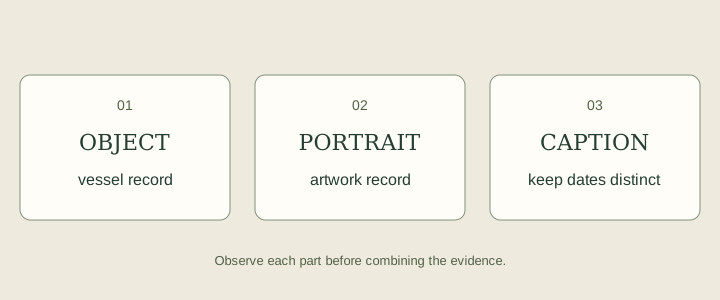
When saving a reference image, retain the source page as well as the image credit and reuse terms. A cropped image detached from its catalogue can lose the very information needed to interpret it. The diagram below is an editorial aid; the linked museum records remain the references for these two examples.
| Part or term | What to record | Why it matters |
|---|---|---|
| Museum vessel | Material and dimensions of the container | A physical object record |
| Drawing | Artist, medium and artwork dimensions | A representation with its own date |
| Provenance note | Confirmed association and stated alternatives | Retains the source’s level of certainty |
Check your understanding
A catalogue lists watercolour as the medium. What does it describe here?
Questions about wicker demijohn
Must a wicker demijohn contain a glass bottle?
No. The Museums Victoria example discussed here contains an earthenware vessel.
Are the dimensions of a drawing the dimensions of its subject?
No. Keep artwork measurements separate from measurements of the represented object.
Does the date of a drawing date the vessel shown?
Not by itself. The date refers to the representation unless the catalogue supplies separate information.
Can these two records authenticate a dealer’s demijohn?
No. They are research comparisons, not an attribution of another object.
Related object guides
Sources and scope
- Museums Victoria: SH 860, Demijohn, wicker and earthenware
- National Gallery of Art: Clarence W. Dawson, Wicker Demijohn
Museum examples are comparisons, not authentication of objects offered elsewhere. The observation record and questions are editorial aids. Research checked 17 October 2026.