Wall Sconces · identification & value
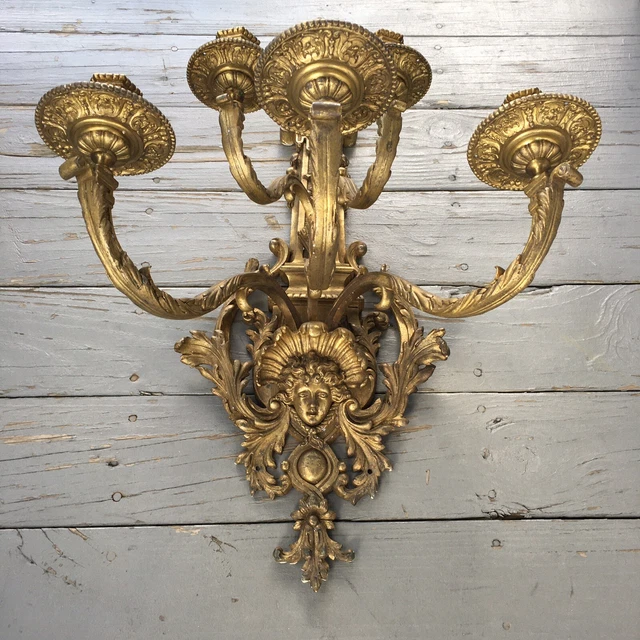
Vintage Candle Sconce
Before electricity, a room was lit by candles on the walls as much as on the tables: in Paris, gilt-bronze arms with leafy branches held candles on either side of the mantel mirror; in the country, a tin or iron sconce with a reflector hung by the door. Mirrored girandoles doubled the light by reflecting the flame.
1700–1930
Typical asking price on live listings
about $195
Median of current eBay asking prices (via PicClick); listings run from $19 to $1,200. Asking prices are not sold prices.
Expert tip
Look at the back plate of a bronze sconce: genuine cast bronze is thick with chiselling marks and a dark, brown-red interior where no gilding was applied; light spelter (zinc) shows a grey colour where scratched, and new brass has a bright yellow back.
History
- Gilt-bronze appliques were a speciality of Paris bronze makers from the Louis XIV period through the 19th century, often in pairs.
- Tole and tin sconces were made for ordinary homes in France and America in the 18th and 19th centuries; many candle sconces were electrified from the late 19th century.
Where it comes from
Paris bronziers for gilt-bronze appliques of the Louis XV, Louis XVI and Empire periods; provincial tinsmiths and blacksmiths for tole and wrought-iron sconces; mirrored girandoles from France, England and Italy; punched-tin farmhouse sconces are mainly American.
Details to look at
- The back plate: chased bronze with leaves and ribbons, painted tole with a scalloped crest, carved wood, or a mirror plate that reflects the flame.
- The arms: one to five, scrolled or straight, ending in bobèches (drip pans) and nozzles sized for candles.
- Pairs: genuine pairs are mirrored left and right in subtle ways, and were cast from the same model with the same finish.
The market: most wanted
- Louis XV and Louis XVI gilt-bronze appliques in pairs, especially with fine chasing and fire gilding.
- 18th and 19th-century mirrored girandoles in giltwood frames.
- Early French tole and wrought-iron sconces with original paint and American punched-tin sconces with reflectors.
Authenticity: period piece or reproduction?
- Fire (mercury) gilding has a warm, soft gold with depth and wears on the high points; electroplated gilding is bright, flat and even.
- Old candle use leaves wax traces, wear and discoloration in the nozzles; electrified pieces should show neatly added holes, not hidden wiring channels cast in.
- Bronze sconces are assembled with threaded rods and hand-cut nuts; modern pieces use standard hex nuts and Phillips screws.
- Warning signs: cast resin and spray-gilt metal, 'antique' sets of four or six all perfectly identical, and mirrored sconces with new mirror glass.
Where to buy
- In France: Puces de Saint-Ouen and Proantic for gilt bronze, Drouot and regional auctions for pairs, L'Isle-sur-la-Sorgue and Leboncoin for tole and iron sconces.
- In the US and UK: 1stDibs and Chairish for French appliques, eBay and Etsy for American tin and brass sconces, Round Top for farmhouse pieces.
Buyer's checklist
- Pairs matching
- Wiring or candle use
- Back plate fixings
- Gilding
Facts
- Typical size
- H 25–60 cm · W 15–40 cm · D 10–25 cm
- Weight
- 0.5–4 kg each
- Period
- 1700–1930
- Materials
- Gilt bronze, brass, tole, wrought iron, wood, mirror glass
- US search interest
- 630 searches a month
Collector interest
US shoppers type 630 searches a month about candle sconce, spread over 22 keyword variants.
By style, searches lean to farmhouse (150), art deco (30), french country (30), rustic (20).
The materials buyers name are bronze (60), brass (30).