Fashion Accessories · identification & value
Art Deco Fan
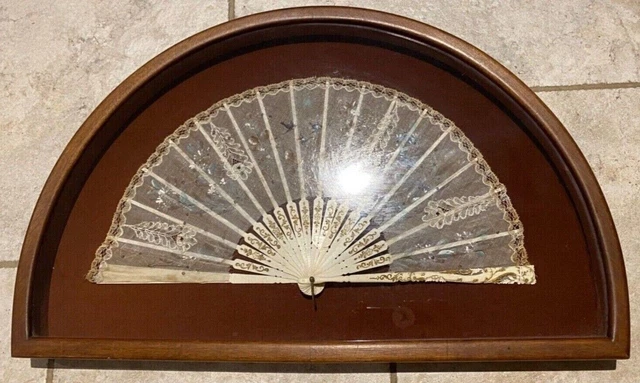
At a Belle Époque ball in Paris, a woman's fan was more than a cooling device; it was a piece of jewellery painted with scenes or covered in lace and sequins, mounted on sticks of carved mother-of-pearl. Fan houses like Duvelleroy, founded in Paris in 1827, sold them in fitted boxes.
1750–1940
Verified market data (US$)
$55 – $715 – $8,800
lowest · median · highest observed
French dealers asking on Proantic: €50–8 000 (median €650, 60 listings). (Proantic prices converted to USD at 1 EUR = $1.10.)
Expert tip
Open a hand fan slowly over a flat surface: the leaf should fold cleanly along every pleat; splits along the folds are the most common damage and cut the value sharply.
History
- The Paris fan trade peaked in the 18th and 19th centuries, with leaf painters in Paris and stick makers in the Oise.
- Duvelleroy was founded in Paris in 1827 and supplied fans to European courts.
- Electric desk and wall fans spread from the 1890s; Art Deco designs like Emerson's Silver Swan (1930s) are collected today.
Where it comes from
Paris for the leaf painting and mounting (Duvelleroy and other éventaillistes); the Oise around Méru and Sainte-Geneviève for the carved sticks in bone, horn, ivory and mother-of-pearl. Electric fans are mostly American (GE, Emerson, Westinghouse) with French versions by Calor in Lyon.
Details to look at
- The sticks and guards: material, carving, piercing and gilding.
- The leaf: painted silk, paper, lace, feathers or printed advertising.
- The rivet (pivot) and its decoration: paste stones or mother-of-pearl.
The market: most wanted
- 18th-century painted fans with carved mother-of-pearl sticks.
- Signed fans by Duvelleroy and other Paris houses in original boxes.
- Belle Époque lace and sequin fans; Art Deco advertising fans; Art Deco electric fans like the Emerson Silver Swan.
Authenticity: period piece or reproduction?
- Old sticks show hand carving and wear on the guards; plastic imitations have moulded lines.
- Painted leaves have fine brushwork; prints are uniform and shiny.
- Electric fans: original cords, cast iron bases, brass blades, and badge labels.
- Warning signs: ivory or tortoiseshell sticks without documentation (trade restricted under CITES and US/UK ivory laws), reproduction Asian fans, and rewired fans with modern plastic parts.
Where to buy
- In France: Drouot and regional auctions for fine fans; Leboncoin, Catawiki and brocantes for Belle Époque and advertising fans.
- In the US and UK: eBay and Etsy for hand fans and electric fans; 1stDibs for fine fans.
Buyer's checklist
- Leaf splits
- Sticks complete
- Rivet condition
- Ivory legal status
Facts
- Typical size
- Hand fan L 20–35 cm closed · electric fan H 30–50 cm
- Weight
- Hand fan 50–200 g · electric fan 3–8 kg
- Period
- 1750–1940
- Materials
- Mother-of-pearl, bone, horn, ivory, silk, paper, lace, feathers; electric fans in cast iron, brass, steel
- US search interest
- 370 searches a month
Collector interest
US shoppers type 370 searches a month about fan, spread over 35 keyword variants.
The styles people attach to it most are art deco (210), french country (20).
Origins in the queries: french (20).