Vintage Christmas Decorations · research note
Christmas cracker wrappers: paper novelties and changing materials
Vintage Christmas decor includes objects designed to last only through a celebration. An unopened cracker preserves a wrapper, a hidden gift and evidence of manufacture in a single fragile package. Museum research shows that the transparent material around such an object may not be what its appearance first suggests.
A French sweet in a British novelty’s history
The V&A connects Tom Smith’s development of the cracker with the paper-wrapped bonbons he encountered in Paris. Its account describes the addition of mottoes and gifts, and the growth of elaborate commercial designs. This is a cross-Channel connection in the history of a British product, not a reason to describe every surviving cracker as French-made.
For a collector’s label, distinguish the place of manufacture from the origin of an idea. A French Country Christmas display may include British paper novelties, provided the decorative setting is not mistaken for the objects’ nationality.
An orange film that needed analysis
A V&A conservation account describes a 1927 Tom Smith cracker whose orange transparent film was initially thought to be cellophane. A period catalogue instead called it gelatine, and analysis of loose fragments confirmed gelatine. The museum also used an X-ray to examine the contents without pulling the cracker open.
The case illustrates two complementary kinds of research: contemporary written description and examination of the surviving material. It does not supply a visual test by which a collector can reliably identify every transparent historic wrapper.
Read packaging as an object in its own right
Photograph an intact wrapper from several sides without opening it to obtain a more complete picture. Transcribe the maker’s name, product name and any printed text exactly. Put uncertain letters in a separate note rather than silently completing them from a similar example.
A box and its contents deserve separate entries. A box can help identify a product range, but objects placed in it later may not belong to that original assortment. Record how the grouping was acquired before describing it as complete.
Separate preservation from recreation
An original unopened cracker and a newly made decorative replica answer different purposes. The first is evidence of a surviving object; the second can illustrate a historical format without consuming that evidence. Label any reconstruction plainly and do not fill an old box with new items while describing the result as original.
For a display note, explain the feature you want viewers to notice: the twist-ended format, a printed name or the contrast between opaque and transparent layers. The historical object can remain interesting even when its hidden gift is unidentified.
| Part or term | What to record | Why it matters |
|---|---|---|
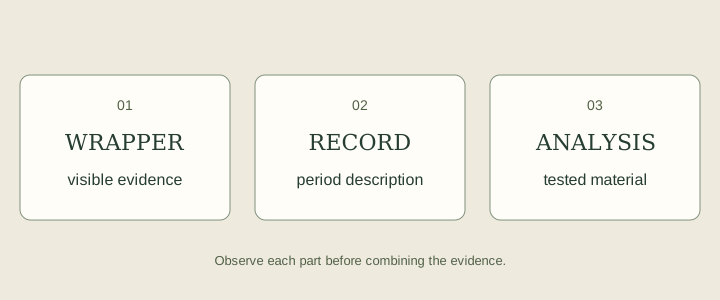
| Wrapper | Text, layers and visible decoration | Records surviving evidence |
| Material claim | Catalogue wording and analysis | Avoids identification from colour alone |
| Box and contents | Individual items and acquisition history | Distinguishes an assortment from later additions |
Check your understanding
Can appearance alone identify every transparent wrapper?
Questions about vintage christmas decor
Were all crackers inspired by France made in France?
No. An influence and a manufacturing location are different facts.
Was the analysed orange film cellophane?
The V&A analysis identified gelatine in that specific example.
Must an old cracker be opened to study it?
No. Its exterior and records can be studied while preserving it intact.
Should a reconstructed assortment be labelled?
Yes. Separate original objects from modern additions.
Related object guides
Sources and scope
Museum examples are comparisons, not authentication of objects offered elsewhere. The observation record and questions are editorial aids. Research checked 18 October 2026.