Vases & Art Glass · identification & value
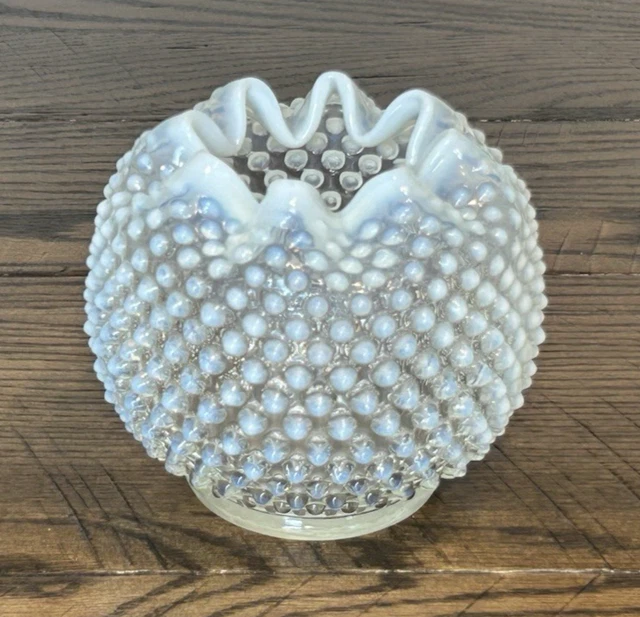
Hobnail Milk Glass Vase
In the 1950s, American brides received white hobnail milk glass vases by the dozen, made in West Virginia glass factories. A century earlier, French glassworks in Lorraine produced opaline vases in white, pink and green, painted or gilded for the mantelpiece.
1850–1980
Expert tip
Hold the vase up to bright light: 19th-century milk glass and opaline often show an amber-red 'fire' at the edges, mid-century American milk glass usually does not; and Fenton pieces made from 1970 carry an embossed 'Fenton' in an oval under the base.
History
- Fenton hobnail milk glass was produced in quantity from the 1950s; Fenton marked its glass with an oval logo from 1970.
- French opaline was made at Baccarat and in Lorraine glassworks in the 19th century; Portieux and Vallérysthal merged in 1872.
Where it comes from
Not French in its best-known form: hobnail milk glass vases are American, from Fenton (Williamstown, West Virginia), Westmoreland and Anchor Hocking; the French equivalent is opaline from Portieux and Vallérysthal (Lorraine) and Baccarat.
Details to look at
- Hobnail pattern: round raised bumps in even rows, with a crimped, ruffled or flared rim.
- Colour: dense white, Jadeite green (Anchor Hocking's Fire-King), or Jeannette's Shell Pink of the late 1950s.
- Base: the embossed Fenton oval (from 1970), remains of a paper label, or a ground pontil on older opaline.
The market: most wanted
- Pre-1970 Fenton hobnail vases with original paper labels, especially large fan and ruffled shapes.
- Jeannette Shell Pink and Fire-King Jadeite vases in clean condition.
- 19th-century French opaline vases from Baccarat, Portieux or Vallérysthal with hand-painted flowers or gilding.
Authenticity: period piece or reproduction?
- Old milk glass shows fine scratches and wear on the base ring from use.
- Mould seams on American pressed glass are fine and even, never sharp.
- French opaline is lighter and more translucent than American milk glass, with hand-applied decoration.
- Warning signs: newer reissues with ground-off marks, chalky over-white glass, and reproductions of Jadeite with a too-bright green and no wear.
Where to buy
- Brocantes, Leboncoin and L'Isle-sur-la-Sorgue for French opaline; occasional American milk glass at Saint-Ouen.
- In the US and UK, eBay, Etsy, antique malls and estate sales, where hobnail milk glass is plentiful.
Buyer's checklist
- Marks
- Fire test
- Chips on crimps
- Colour
Facts
- Typical size
- H 10–30 cm
- Weight
- 200 g–1.5 kg
- Period
- 1850–1980
- Materials
- Milk glass, opaline, opalescent glass
- US search interest
- 180 searches a month
Collector interest
Milk vase draws 180 monthly US searches, split into 8 keyword variants.
Material searches favour glass (180).