Nautical & Travel · identification & value
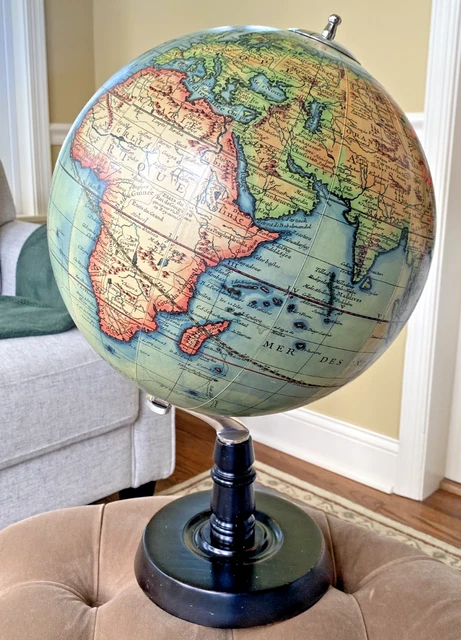
Vintage Globe on Stand
In a 19th-century French school or study, a globe on a turned wooden stand stood beside the bookcase, its paper gores slowly yellowing under varnish. Paris map-makers such as the Delamarche family had made globes since the late 18th century, and their names, printed on a small cartouche on the sphere, are still the first thing a collector looks for.
1800–1970
Typical asking price on live listings
about $95
Median of current eBay asking prices (via PicClick); listings run from $2.5 to $5,000. Asking prices are not sold prices.
Expert tip
Date the globe from its political map: 'Persia' before 1935, 'Siam' before 1939, no USSR before 1922, 'Gold Coast' before 1957, 'Ceylon' before 1972; the latest name on the globe gives the earliest possible date.
History
- Charles-François Delamarche established a leading Paris globe business in the late 18th century, continued by his son; Paris makers such as J. Forest and Girard & Barrère followed in the 19th and early 20th centuries.
- In the 20th century, Columbus in Berlin and Replogle in Chicago (founded 1930) made globes in large numbers, many with illuminated or brass stands.
Where it comes from
Paris for French globes: Delamarche, J. Forest, Girard & Barrère, J. Lebègue and Taride; London for Cary, Newton and Malby; Berlin for Columbus; Chicago for Replogle.
Details to look at
- The maker's cartouche printed on the sphere, with name and often address or date.
- Rings: the brass or paper meridian ring and the horizon ring with calendar and zodiac.
- Stand: turned wood, cast iron, brass or Art Deco chrome.
The market: most wanted
- 19th-century Paris globes by Delamarche or J. Forest with a complete horizon ring and brass meridian.
- Large floor globes (spheres over 45 cm) on mahogany or walnut stands with stretchers and compass.
- Matched pairs of terrestrial and celestial globes from the same maker.
Authenticity: period piece or reproduction?
- Hand-applied paper gores (the long tapering strips of map) show slight misalignment where they meet and a warm yellow-brown varnish that has crazed.
- Old plaster or papier-mâché spheres crack along the equator and show dents; tap gently and they sound solid, not hollow plastic.
- The maker's cartouche, the map content and the borders shown should all agree with a single edition date.
- Warning signs: modern globes printed with an 'antique' tone and no cartouche, plastic or metal spheres, perfectly matched seams, and a period sphere on a new stand.
Where to buy
- In France, Proantic, Saint-Ouen and Drouot for 19th-century globes; Leboncoin and brocantes for school globes.
- In the US and UK, 1stDibs, Chairish and eBay; specialist scientific-instrument dealers.
Buyer's checklist
- Cartouche
- Map date
- Seam condition
- Stand original
Facts
- Typical size
- Ø 15–50 cm · H 30–110 cm
- Weight
- 1–20 kg
- Period
- 1800–1970
- Materials
- Papier-mâché or plaster sphere, printed paper gores, varnish, wood, brass, cast iron
- US search interest
- 160 searches a month
Collector interest
US shoppers type 160 searches a month about globe stand, spread over 15 keyword variants.
Material searches favour wooden (40), brass (10).