Figurines, Ornaments & Tiles · identification & value
Art Deco & Metal Ceiling Tiles
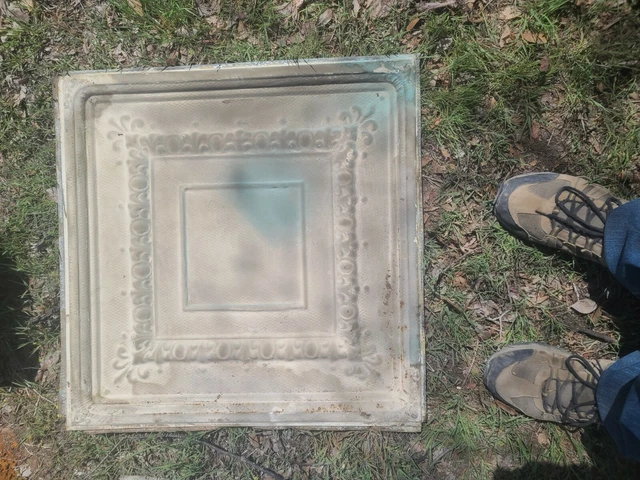
In late-19th-century America, a grocery store or saloon could afford an ornate ceiling by nailing up pressed-metal panels stamped with rosettes and egg-and-dart borders and then painting them. In Paris, the same ornate effect came from moulded plaster, cast in workshops and fixed in place.
1880–1940
Typical asking price on live listings
about $142
Median of current eBay asking prices (via PicClick); listings run from $2.5 to $14,700. Asking prices are not sold prices.
Expert tip
Hold a magnet to the back of a 'vintage copper' ceiling tile: original pressed ceilings were tin-plated steel and the magnet sticks; solid copper or aluminium tiles are modern decorative products.
History
- Pressed-metal ceilings were popular in the US from the 1880s to the 1930s; W.F. Norman was founded in 1898 and still produces patterns from its original dies.
- Lincrusta (patented by Frederick Walton in 1877) and Anaglypta (1887) were embossed wall and ceiling coverings in Britain.
Where it comes from
Not French: pressed-metal ceilings are an American specialty (W.F. Norman of Nevada, Missouri; Wheeling Corrugating of West Virginia); French equivalents are moulded plaster ('staff') and painted ceilings, and the English made Lincrusta and Anaglypta relief ceilings.
Details to look at
- The pattern: Victorian rosettes and egg-and-dart borders, or Art Deco stepped and geometric designs.
- Nail holes along every edge and in the corners, and the number of paint layers visible where it chips.
- Matching field, filler, border and cornice pieces, which were sold separately to complete a ceiling.
The market: most wanted
- Large matched runs of original pressed-tin panels with their borders and cornice, enough for a whole room.
- Art Deco geometric patterns with crisp, undamaged relief.
- Early panels in documented catalogue patterns by W.F. Norman or Wheeling, and original Lincrusta in good condition.
Authenticity: period piece or reproduction?
- Salvaged panels show rows of old nail holes along the edges, often torn slightly where they were prised off.
- The steel is magnetic and rusts orange-brown wherever the paint has chipped.
- Several paint layers show at the edges; the first coats on pre-1978 panels may contain lead, so test before sanding.
- Warning signs: thin aluminium or PVC tiles with a printed 'patina', faux-copper finishes, a single clean paint coat and no nail holes at all.
Where to buy
- In the US, architectural salvage yards in older Midwest and East Coast cities, plus eBay and Etsy for single panels sold as wall art.
- In France, look instead for moulded plaster ornaments and ceiling roses at architectural salvage dealers; in the UK, salvage yards and decorators' suppliers for Lincrusta and Anaglypta.
Buyer's checklist
- Magnet
- Nail holes
- Lead paint
- Quantity
Facts
- Typical size
- 60 × 60 cm or 60 × 120 cm
- Weight
- 1–2 kg per tile
- Period
- 1880–1940
- Materials
- Tin-plated steel, plaster, paint
- US search interest
- 160 searches a month
Collector interest
Search demand for ceiling tile reaches 160 US searches a month across 11 distinct queries.
By style, searches lean to art deco (80).
Material searches favour metal (40), copper (20).
Related in Figurines, Ornaments & Tiles
- Spanish Tile
- Vintage Christmas Ornament
- Antique Staffordshire Dog
- Antique Figurine
- Vintage Ornaments
- Antique Floor Tile
- Vintage Tile Backsplash
- Vintage Backsplash Tile
Go deeper: research notes
The Vintage Christmas Decorations: An Identification Guide gathers 12 sourced object studies, including: