Candlesticks & Fireplace · identification & value
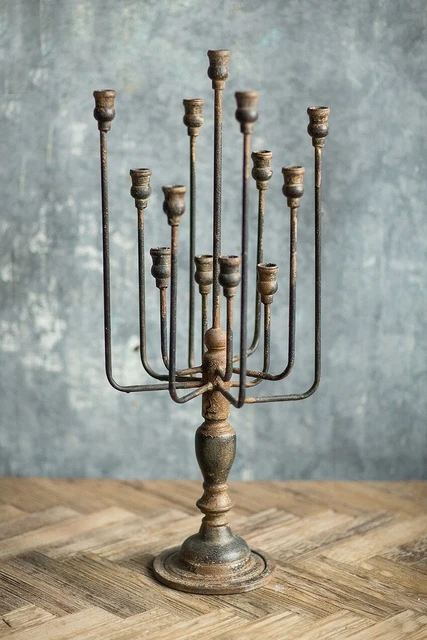
Vintage Candelabra
On a 19th-century French mantelpiece the clock never stood alone: it was flanked by a pair of candelabra cast in the same bronze or marble, forming a garniture. In churches, taller candelabra with branches stood on the altar steps, and many came onto the market after closures and inventories.
1780–1920
Guide price (US$)
$100 – $450 – $3,000
low · typical · high, dealer level
Price tip: under $100 is a bargain worth checking twice; above $3,000, ask for provenance or a maker's mark.
Expert tip
Unscrew a branch and look at the thread and the inside of the casting: bronze is a warm brownish-gold metal when scratched, spelter is grey and lighter, and hand-cut old threads are irregular compared with modern machine threads.
History
- Gilt-bronze candelabra were a speciality of Paris bronziers from the 18th century; the 19th century produced them in quantity in Empire, Louis XVI revival and Napoleon III styles.
- Church furnishing workshops in Paris and Lyon supplied brass and gilt-bronze altar candelabra throughout the 19th century.
Where it comes from
Paris for gilt-bronze candelabra and mantel garnitures; Lyon and Paris church suppliers (such as Poussielgue-Rusand) for altar candelabra; provincial foundries for brass and spelter.
What sets the price
Pairs, bronze, crystals.
Details to look at
- Chasing and gilding quality on the arms and base.
- Number of lights and whether the branches detach.
- Crystal drops and bobeches on girandole versions.
The market: most wanted
- Pairs of Empire and Louis XVI gilt-bronze candelabra.
- Napoleon III garniture candelabra with matching clock.
- Large church candelabra with original gilding, and crystal-hung girandoles.
Authenticity: period piece or reproduction?
- Bronze castings are heavy and chased after casting; spelter is cast smooth and hollow.
- Fire gilding wears softly on high points, revealing bronze; gilt paint flakes.
- Pairs should match in casting details but show small hand variations.
- Warning signs: brass-plated spelter, new electroplating, Phillips screws and mismatched branches.
Where to buy
- Drouot, Proantic and Saint-Ouen for gilt-bronze pairs; L'Isle-sur-la-Sorgue and regional brocantes for church and brass candelabra.
- In the US and UK, 1stDibs, Chairish and eBay. The guide range is $100–3,000.
Buyer's checklist
- Pair matches
- Bronze vs spelter
- Branches complete
- Gilding or plating wear
Facts
- Typical size
- H 30–90 cm · W 20–45 cm
- Weight
- 2–12 kg each
- Period
- 1780–1920
- Materials
- Gilt bronze, brass, spelter, marble, crystal
- US search interest
- 2,940 searches a month
Collector interest
Search demand for candelabra reaches 2,940 US searches a month across 48 distinct queries.
By style, searches lean to baroque (30), rustic (20), art deco (10), art nouveau (10).
Most-searched materials: brass (1,330), wooden (110), silver (90), pewter (80).
Related in Candlesticks & Fireplace
- Candle Holder
- French Fireplace
- Antique Candlestick
- Antique Andiron
- Antique Fireplace Mantel
- Antique Fireplace Tool
- French Candles
- Antique Fireplace Screen
Go deeper: research notes
The Vintage Brass Candlesticks: An Identification Guide gathers 11 sourced object studies, including: