Brocante & Vintage Finds · identification & value
Antique Scythe
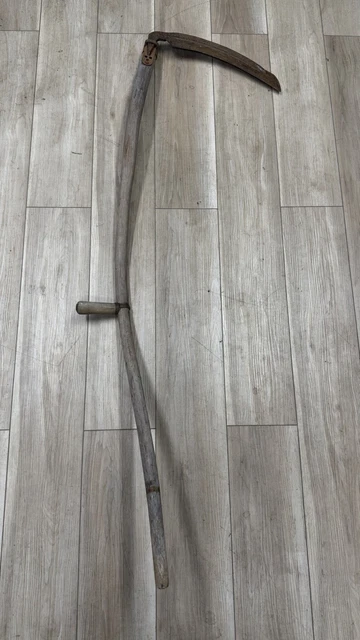
At haymaking the line of mowers moved row by row: scythes whistling in the dawn, the snath curved to the mower's shoulder, the blade sharpened every hour with a pebble from the pocket.
1850–1950
Typical asking price on live listings
about $68
Median of current eBay asking prices (via PicClick); listings run from $2.5 to $3,000. Asking prices are not sold prices.
Expert tip
Read the blade stamp near the back: French makers stamped the steel inside a shield or cartouche — a blank blade is an anonymous import, however good the edge looks.
History
- Scythes were standard French farm equipment until the machine replaced the line.
- Blade districts such as Thiers and Nogent stamped their steel with the maker's mark.
- The snath — the curved shaft — was hand-shaved by the mower or the village smith.
Where it comes from
French edge-tool districts — Thiers for blades, Nogent for the finer work — forged the blades; village smiths fitted the snaths.
Details to look at
- Maker's stamp inside a shield or cartouche on the blade back.
- Hand-shaved snath, curved and fitted with two grip pegs.
- Ferrule and mounting rings adjustable for the blade angle.
The market: most wanted
- Stamped Thiers and Nogent blades.
- Complete snaths with original grip pegs and ferrules.
- Hay and grain blades of different lengths kept as a pair.
Authenticity: period piece or reproduction?
- Hammer marks from hand forging run along the blade back.
- The edge shows decades of peening, thin and wavy.
- Warning signs: smooth ground blades without a stamp, machine-turned snaths, and ferrules of modern galvanised sheet.
Where to buy
- French farm brocantes and tool collectors; US blade collectors also buy French stamped steel.
- A stamped blade with its original snath is the set to buy — separated, both halves lose half their interest.
Buyer's checklist
- Blade stamp
- Edge peening
- Snath shape
- Ferrule original
Facts
- Typical size
- Blade 60–90 cm · snath 140–170 cm
- Weight
- 1–2.5 kg complete
- Period
- 1850–1950
- Materials
- Forged steel blade, hand-shaved wooden snath, iron ferrule
- US search interest
- 1,670 searches a month
Collector interest
Scythe draws 1,670 monthly US searches, split into 9 keyword variants.
Searcher intent: 28% want to buy; 40% ask what it is worth.