Baskets & Wicker · identification & value
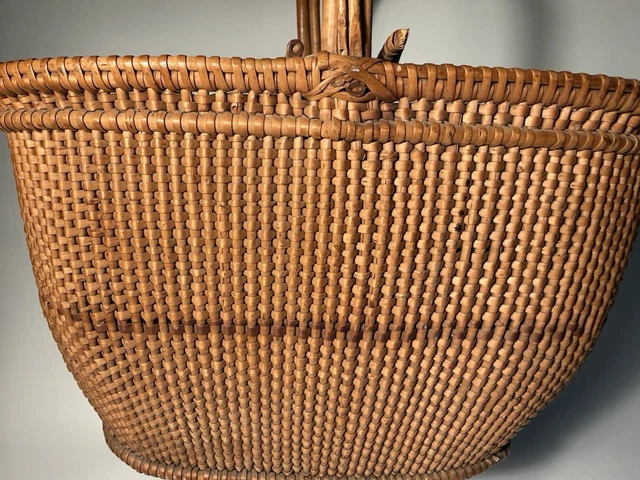
Vintage Wicker Basket
Before plastic crates, every French farm and market ran on willow. Grape pickers filled tall hottes carried on the back, bakers lined long panières with linen for baguettes, and the housewife walked to market with a lidded panier on her arm. Many of these baskets were woven in winter by farmers who grew their own osier along the riverbanks.
1880–1960
Guide price (US$)
$20 – $80 – $400
low · typical · high, dealer level
Price tip: under $20 is a bargain worth checking twice; above $400, ask for provenance or a maker's mark.
Expert tip
Turn the basket over: a French willow basket has a woven base built on thick stakes, often with runners underneath, and the handle bow is pushed deep down into the side weave beside a stake. Staples, glue or a handle tacked on top mean a modern import.
History
- Willow growers at Villaines-les-Rochers formed one of France's first agricultural cooperatives in 1849, and the village still weaves today.
- The École nationale d'osiériculture et de vannerie opened at Fayl-Billot in 1905 to train basket makers; most collected French baskets date from about 1880 to 1960.
Where it comes from
Villaines-les-Rochers (Indre-et-Loire), the willow-weaving village of the Touraine, and Fayl-Billot (Haute-Marne), home of France's national basketry school; country baskets came from every wine and market region.
Details to look at
- Close, even rows of whole or split willow (osier) with a strong border rim.
- Wear on the handle wrap and the base runners from years of use.
- Old repairs in matching willow, and traces of the original use (flour, grape stains, feathers).
The market: most wanted
- Large grape-harvest hottes and vendange baskets with shoulder straps.
- Long boulangerie bread baskets and round bannetons with linen lining.
- Lidded market baskets, egg baskets and fishing creels in fine, tight weave.
Authenticity: period piece or reproduction?
- Handmade willow shows small variations in rod thickness and colour; machine-made or Asian rattan copies look uniform.
- Period baskets have a dry, greyish-honey patina deep in the weave, not just on the surface.
- A hand-woven border is finished by turning the stakes down into the weave, with no cut ends glued in place.
- Warning signs: spray-on 'aged' stain, staples, wire cores, plastic-coated rods and sets of identical 'French market baskets'.
Where to buy
- Regional brocantes and vide-greniers in the Loire and Burgundy, L'Isle-sur-la-Sorgue, Leboncoin and Selency; the cooperative shop at Villaines-les-Rochers for new work in the traditional shapes.
- Etsy, eBay and Chairish for imported French baskets; the guide range is $20–400, with grape hottes and large bakers' baskets at the top.
Buyer's checklist
- Base and runners sound
- Handle firmly woven in
- No brittle broken rods
- Weave hand-finished, no staples
Facts
- Typical size
- H 15–80 cm · W 25–70 cm
- Weight
- 0.3–3 kg
- Period
- 1880–1960
- Materials
- Willow (osier), split chestnut, rush, leather or iron fittings
- US search interest
- 270 searches a month
Collector interest
US shoppers type 270 searches a month about wicker basket, spread over 12 keyword variants.
Material searches favour wicker (270).
Searches by country of origin: french (40).
Related in Baskets & Wicker
- Antique Egg Basket
- Vintage Laundry Basket
- Wicker Suitcase
- Antique Wicker Rocker
- Vintage Picnic Basket
- Vintage Baskets with Handles
- Wicker Baskets & Bassinets on Wheels
- Vintage Wire Basket
Go deeper: research notes
The Antique Baskets: An Identification Guide gathers 11 sourced object studies, including: