Scientific & Measuring Instruments · identification & value
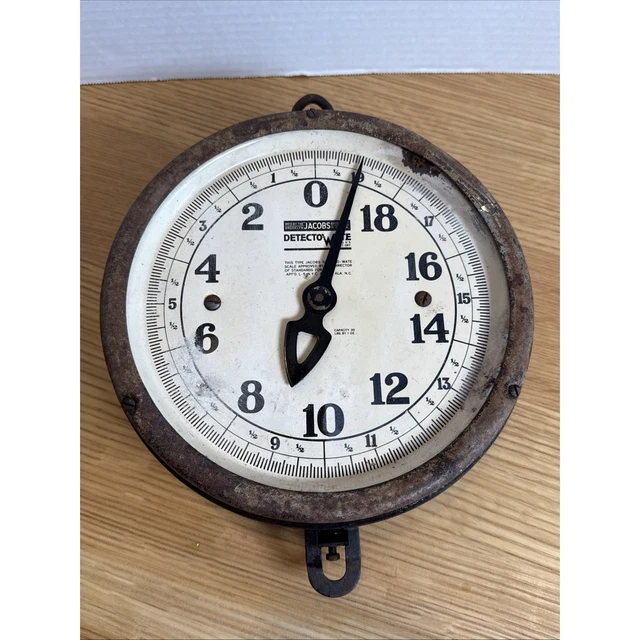
Vintage Detecto Scale
In doctors' surgeries and school nurses' rooms of mid-century America, the tall white Detecto balance with its sliding brass weights and fold-up height rod was the place where every child was measured. The same company made the pastel bathroom scales of the 1950s, and both now sell to collectors of medical and kitchen Americana.
1930–1980
Expert tip
With nothing on the platform, slide both poises to zero and watch the beam tip: on a sound physician's scale it should settle and float in the middle of its slotted guide; if it slams against one end, the knife edges or linkage under the platform need attention.
History
- Detecto was a Brooklyn-based scale maker for much of the 20th century, known for physicians' beam scales and bathroom scales.
- The brand later passed to Cardinal Scale of Webb City, Missouri, which still uses the Detecto name.
Where it comes from
Not French: Detecto is an American brand that began in Brooklyn, New York, and later became part of Cardinal Scale in Webb City, Missouri. The French equivalents a collector meets at brocantes are Testut (Paris) and Trayvou (near Lyon) scales.
Details to look at
- Beam: engraved or stamped graduations in pounds and sometimes kilograms, with large and small sliding poises.
- Height rod: telescoping measuring rod with a folding head piece, often missing on used scales.
- Column and base: cast-iron base with enamel finish, rubber mat on the platform, and casters on some models.
The market: most wanted
- Early Brooklyn-marked physician's beam scales with height rod complete.
- 1950s Detecto bathroom scales in original pastel colours (pink, turquoise, yellow) with clear dials.
- Baby and infant scales with curved trays.
Authenticity: period piece or reproduction?
- The base should carry cast or stamped 'Detecto' and the factory town; Brooklyn marks indicate the older production.
- Original enamel is thick, slightly yellowed white with chips showing grey cast iron.
- Beam graduations should be crisp and the poises should slide with a light click at each notch.
- Warning signs: a repainted scale with bright white spray over rust, missing height rod or poises replaced by other makers' parts, and bathroom scales with cracked or replaced dials.
Where to buy
- In France, Detecto scales are rare; look at Saint-Ouen industrial-design dealers and on Leboncoin, or buy Testut and Trayvou scales at brocantes as French alternatives.
- In the US, eBay, Etsy, medical-equipment surplus, estate sales and industrial antiques dealers; local pickup is best for the heavy physician's scales.
Buyer's checklist
- Zero balance
- Height rod
- Factory marks
- Enamel condition
Facts
- Typical size
- Physician's scale H 140–150 cm · base 27 × 36 cm; bathroom scale 25 × 30 cm
- Weight
- Physician's scale 15–25 kg; bathroom scale 2–4 kg
- Period
- 1930–1980
- Materials
- Cast iron, enamelled steel, brass or chrome beam, rubber mat
- US search interest
- 230 searches a month
Collector interest
US shoppers type 230 searches a month about detecto scale, spread over 8 keyword variants.
Searcher intent: 9% want to buy.