Posters & Advertising · identification & value
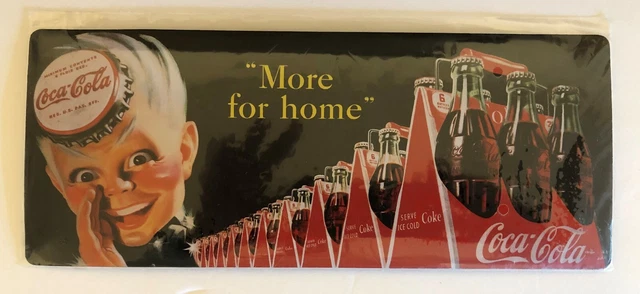
Vintage Coca-Cola Sign
In the 1950s, the red Coca-Cola button sign hung outside drugstores and gas stations across America, often with the bottle image in the centre. It was porcelain enamel, made to survive years of sun and rain, and today it is one of the most copied signs in the advertising field.
1930–1970
Typical asking price on live listings
about $46
Median of current eBay asking prices (via PicClick); listings run from $2.5 to $3,000. Asking prices are not sold prices.
Expert tip
Run a fingertip across the boundaries between colours: on genuine porcelain enamel each colour was fired as a separate layer, so you can feel slight ledges; a painted or digitally printed copy is perfectly smooth.
History
- Coca-Cola was first sold in Atlanta in 1886; porcelain enamel signs became a major advertising medium in the early 20th century.
- Button signs were made in several diameters in the 1950s; 'fishtail' signs followed around 1958–1965.
Where it comes from
Not French: the classic round Coca-Cola 'button' signs are American porcelain-enamel signs from the 1950s; French and European bottlers also issued enamelled Coca-Cola plaques after the Second World War.
Details to look at
- Diameter (the buttons came in standard sizes from roughly 12 to 48 in) and graphics: bottle in the centre, 'Drink Coca-Cola', or the script alone.
- Mounting holes: genuine signs have neatly finished holes with metal grommets; copies often have raw drilled holes.
- The lower edge or back: maker's name, 'Made in U.S.A.' and sometimes a date code fired into the enamel.
The market: most wanted
- 1950s porcelain button signs with the bottle image, especially 36 and 48 in examples in strong colour.
- Earlier porcelain signs of the 1930s–40s with 'Drink Coca-Cola in Bottles' wording.
- Fishtail signs from the late 1950s and 60s, and French or Canadian bilingual enamelled plaques.
Authenticity: period piece or reproduction?
- Genuine porcelain enamel is glass fused to steel: a chip shows a dark blue or black ground coat and grey steel, with rust spreading under the glass edge.
- The back of a period sign is also enamelled (often dark) and shows weathering and old fixing marks.
- The red of 1950s signs is a deep, even tone; under raking light, white letters stand slightly raised over the red.
- Warning signs: Indian or other reproduction porcelain signs with lumpy edges, a too-orange red, brown paint dabbed on as fake rust, rust inside chips that is perfectly uniform, and no maker's mark.
Where to buy
- In France, Leboncoin, brocantes and Catawiki for European enamelled Coca-Cola plaques (search 'plaque émaillée Coca-Cola').
- In the US, eBay, advertising and petroliana shows, specialist dealers and auction houses such as Morphy; ask for provenance and close-up photos of chips and the back.
Buyer's checklist
- Colour layers
- Chip structure
- Maker's mark
- Grommets
Facts
- Typical size
- Ø 30–120 cm
- Weight
- 1–15 kg
- Period
- 1930–1970
- Materials
- Porcelain enamel on steel, lithographed tin
- US search interest
- 230 searches a month
Collector interest
Cola sign draws 230 monthly US searches, split into 13 keyword variants.