Frames · identification & value
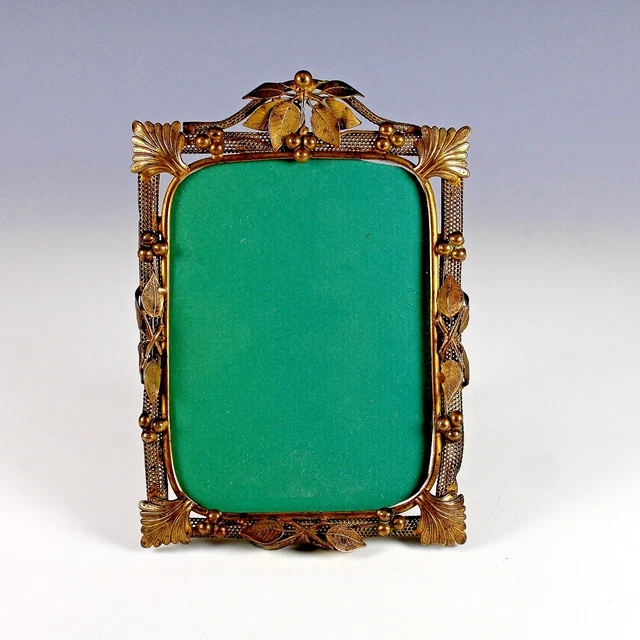
Vintage Photo Frame
When Daguerre's invention was announced in Paris in 1839, portraits became affordable to the middle class within a generation. By the 1860s, card photographs were displayed in frames on mantelpieces and pianos, and the frame became a decorative object in its own right.
1860–1940
Typical asking price on live listings
about $200
Median of current eBay asking prices (via PicClick); listings run from $11 to $1,350. Asking prices are not sold prices.
Expert tip
On an English silver frame, find the four marks on the front edge: lion passant for sterling, a town mark (anchor for Birmingham, three wheatsheaves and a sword for Chester), a date letter and the maker's initials; on a French one, look for the Minerva head.
History
- The daguerreotype was presented in Paris in 1839; the carte de visite format spread in the 1860s.
- Hallmarked silver frames flourished in Edwardian England (1900–1910); Art Nouveau pewter frames by WMF and Liberty's Tudric line date from around 1900.
Where it comes from
Paris for brass, bronze and velvet frames of the Napoleon III and Belle Époque periods; Birmingham and Chester in England for hallmarked silver frames; WMF at Geislingen in Germany and Liberty in London for Art Nouveau pewter frames.
Details to look at
- Material: silver sheet, silver plate, pewter, gilt brass or bronze, guilloché enamel, carved wood or velvet.
- Back: easel strut on a brass hinge, velvet, leather or moiré silk backing, and a turn-button or clip closure.
- Opening: oval, round, arched or rectangular, often sized for the carte de visite (about 6 × 9 cm) or cabinet card (about 11 × 16 cm).
The market: most wanted
- Edwardian hallmarked silver frames from Birmingham and Chester, especially Art Nouveau designs with embossed flowers.
- Art Nouveau pewter frames by WMF (stamped with an ostrich mark) and Liberty Tudric.
- Napoleon III gilt-bronze and velvet frames, and guilloché enamel frames from the Belle Époque.
Authenticity: period piece or reproduction?
- English silver frames are thin sheet stretched over a wooden back; the marks sit together on the front border and should be crisp, not blurred.
- Old easel backs are velvet or leather over card with a brass hinge; replaced backs are MDF with a plastic strut.
- French silver frames carry the Minerva head and a lozenge maker's mark; 'métal argenté' means plated.
- Warning signs: hallmarks cast into the design rather than struck, 'sterling' stamped on plated brass, and new frames finished with black wax to look old.
Where to buy
- Saint-Ouen, regional brocantes and Leboncoin for French brass, bronze and velvet frames; Catawiki for silver and enamel.
- In the US and UK, eBay, Etsy, Portobello Road and specialist silver dealers; antiques fairs such as Newark for quantity.
Buyer's checklist
- Hallmarks
- Back
- Opening size
- Condition of glass
Facts
- Typical size
- Overall 15–30 cm · openings 9 × 13 to 13 × 18 cm
- Weight
- 0.1–1 kg
- Period
- 1860–1940
- Materials
- Silver, silver plate, pewter, brass, bronze, velvet, leather, wood
- US search interest
- 230 searches a month
Collector interest
Search demand for photo frame reaches 230 US searches a month across 31 distinct queries.
By style, searches lean to art deco (70), farmhouse (40), victorian (30), french country (20).
The materials buyers name are silver (20), copper (10), pewter (10).
Related in Frames
Go deeper: research notes
The Vintage Picture Frames: An Identification Guide gathers 11 sourced object studies, including: