Doors, Shutters & Hardware · identification & value
Vintage Door Knocker
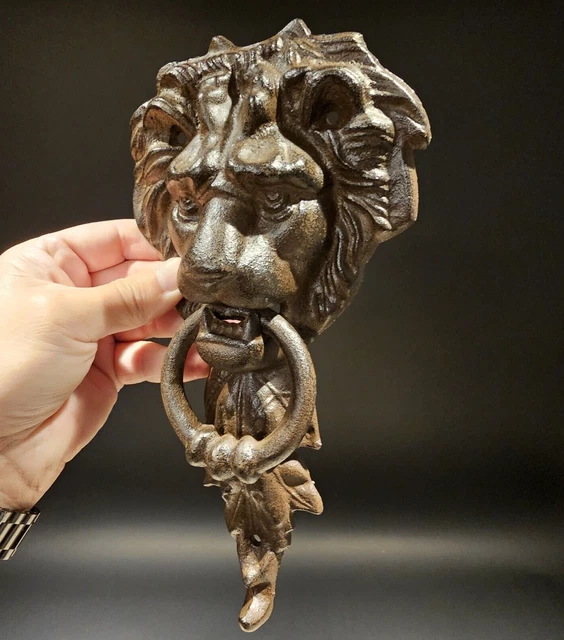
Before doorbells, a visitor announced himself by lifting a heavy iron or bronze knocker and letting it fall on a stud. In villages of southern France, the knocker in the shape of a woman's hand holding a ball is still a familiar sight on old doors, while grander town houses preferred lion masks and heavy bronze rings.
1700–1930
Guide price (US$)
$30 – $120 – $600
low · typical · high, dealer level
Price tip: under $30 is a bargain worth checking twice; above $600, ask for provenance or a maker's mark.
Verified market data (US$)
$121 – $418 – $4,620
lowest · median · highest observed
French dealers asking on Proantic: €110–4 200 (median €380, 60 listings). (Proantic prices converted to USD at 1 EUR = $1.10.)
Expert tip
Check where the knocker strikes: a knocker that hung on a door for generations has a worn, flattened spot on its striking boss and a matching dent on the plate, while a new one has crisp, unworn contact points and round machine-drilled fixing holes.
History
- Hand-forged iron knockers were made by village blacksmiths from the Middle Ages through the 19th century, often with chiselled decoration.
- Cast bronze and brass knockers in lion, mask and ring forms became common in the 18th and 19th centuries, when foundries supplied them by catalogue.
Where it comes from
Provincial blacksmiths for wrought-iron knockers (heurtoirs), with the hand-holding-a-ball knocker especially common in southern France; Paris and provincial foundries for cast bronze and brass lion, mask and ring knockers.
What sets the price
Age, design, size.
Details to look at
- The striking boss and plate, and how worn they are.
- Metal and making: hammered iron with chisel work, or cast bronze and brass with chased detail.
- Subject: hand with ball, lion's head, ring, dolphin or mask, and the quality of the modelling.
The market: most wanted
- Early hand-forged iron knockers with chiselled or pierced decoration.
- Heavy 19th-century bronze lion-head and mask knockers from French town houses.
- Large, finely modelled hand knockers with cuffs, rings or bracelets.
Authenticity: period piece or reproduction?
- Old wrought iron shows hammer marks, uneven section and layered rust in the recesses.
- Cast bronze has a dense weight and a soft brown patina in the hollows, with polishing wear on the high points.
- Square-shanked spikes or hand-cut threaded bolts are consistent with age.
- Warning signs: identical new castings sold in pairs, a chemical patina that rubs off on a cloth, and bright machine-threaded bolts.
Where to buy
- Regional brocantes, Leboncoin and L'Isle-sur-la-Sorgue for French hand and ring knockers; architectural salvage yards for large town-house pieces.
- In the US and UK, eBay, Etsy and architectural salvage dealers. The guide range is $30–600.
Buyer's checklist
- Wear on striking point
- Fixings original
- Iron, bronze or brass
- Size suits your door
Facts
- Typical size
- H 10–30 cm · W 7–20 cm
- Weight
- 0.5–3 kg
- Period
- 1700–1930
- Materials
- Wrought iron, bronze, brass, cast iron
- US search interest
- 2,670 searches a month
Collector interest
Door knocker draws 2,670 monthly US searches, split into 29 keyword variants.
By style, searches lean to victorian (110), art deco (60).
The materials buyers name are brass (1,740).
Related in Doors, Shutters & Hardware
- Antique Door
- Antique Door Knob
- Vintage Front Door
- Antique Shutter
- Antique Door Hardware
- Antique Cabinet Door
- Antique Door Lock
- Antique Door Hinge
Go deeper: research notes
The Vintage Door Handles: An Identification Guide gathers 11 sourced object studies, including: