Cabinets, Benches & Furniture Buying · identification & value
Antique Liquor Cabinet
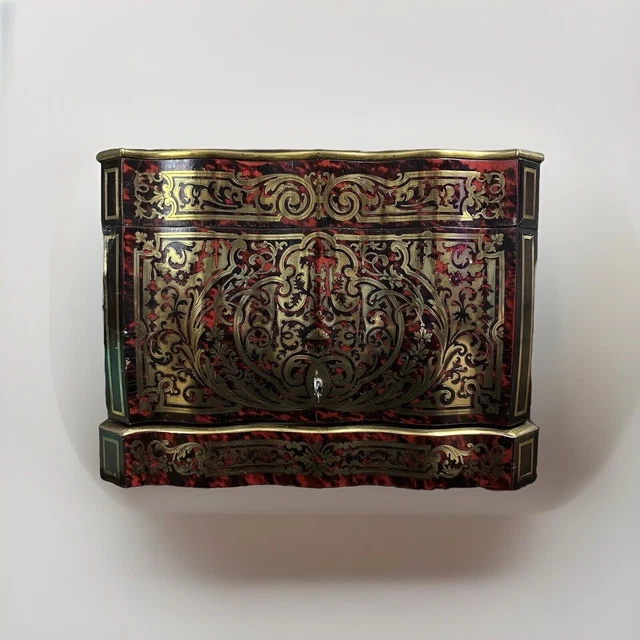
After dinner in a Second Empire Paris household, the host unlocked a small chest on the sideboard; the front and lid swung open together and a gilt-brass tray lifted out, bringing up decanters of cognac, kirsch and liqueur with tiny gilded glasses. The lock kept the servants honest, and the brass inlay showed off the owner's taste.
1850–1965
Typical asking price on live listings
about $142
Median of current eBay asking prices (via PicClick); listings run from $2.5 to $10,000. Asking prices are not sold prices.
Expert tip
Count the glasses and decanters in a cave à liqueur: they were usually fitted with four carafes and twelve to sixteen glasses in a lift-out tray; a complete set in matching cut or gilded crystal is worth far more than one refilled with odd glasses.
History
- The cave à liqueur was a Napoleon III (1852–1870) speciality, made by Paris tabletiers in ebonised pearwood, rosewood, burr wood and boulle work.
- The English tantalus, a locking frame displaying decanters, was patented by George Betjemann & Sons in the 1880s.
- Art Deco bar cabinets of the 1920s–30s and Italian globe bars of the 1950s–60s brought the drinks cabinet into living rooms.
Where it comes from
Paris for the Napoleon III cave à liqueur, a locking box in ebonised wood, rosewood or boulle marquetry; England for the tantalus (patented by Betjemann in the 1880s); Paris and the US for Art Deco bar cabinets; Italy for 1950s–60s globe bars.
Details to look at
- The inlay: brass and mother-of-pearl, or tortoiseshell and brass boulle.
- The interior: gilt-brass fittings, lift-out tray and sometimes a hidden drawer.
- The glassware: cut, engraved or gilded crystal, matching throughout.
The market: most wanted
- Napoleon III caves à liqueur with complete crystal sets and boulle or brass inlay.
- Tantalus frames by Betjemann with original key and decanters.
- Art Deco bar cabinets in macassar or burr walnut by known French ébénistes.
Authenticity: period piece or reproduction?
- Old ebonised wood and veneer show shrinkage cracks and inlay lifting slightly; brass inlay has darkened patina.
- The interior gilt-brass fittings are fire-gilded or gilt with wear at touch points; replacements are bright.
- Glasses with gilded rims and matching engraving; Baccarat or other crystal rings when tapped.
- Warning signs: mismatched glasses, missing tray, modern replacement locks, and resin inlay instead of mother-of-pearl.
Where to buy
- In France: Saint-Ouen, Proantic, Drouot and regional auctions for caves à liqueur; Leboncoin for Art Deco cabinets.
- In the US and UK: 1stDibs, Chairish and eBay; English dealers for tantalus sets.
Buyer's checklist
- Glass count
- Lock and key
- Inlay condition
- Hidden drawer
Facts
- Typical size
- Cave à liqueur H 25–30 cm · W 30–40 cm · D 22–30 cm; bar cabinets H 120–170 cm
- Weight
- 5–12 kg (cave à liqueur); 40–100 kg (bar cabinets)
- Period
- 1850–1965
- Materials
- Ebonised pearwood, rosewood, burr wood, brass, mother-of-pearl, crystal, gilt brass, macassar
- US search interest
- 350 searches a month
Collector interest
Liquor cabinet draws 350 monthly US searches, split into 13 keyword variants.
Style words in the queries: art deco (70), victorian (20), retro (10).