Cabinets, Benches & Furniture Buying · identification & value
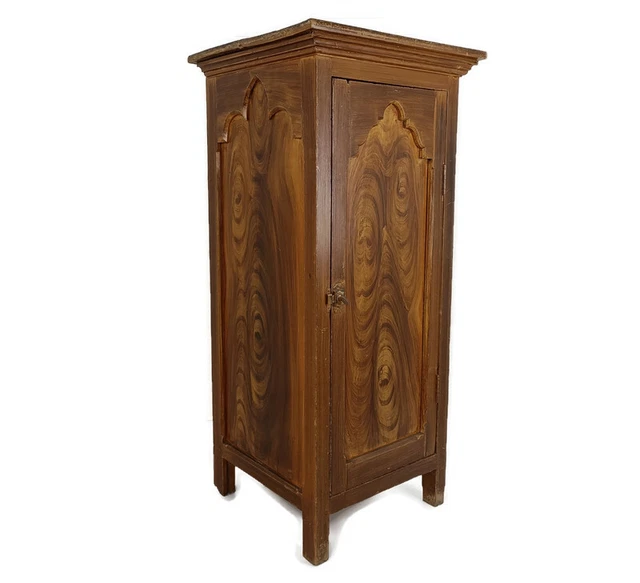
Vintage Filing Cabinet
By 1900, the modern office had discovered the vertical file, and American makers sold oak cabinets with deep drawers in which folders stood upright, indexed with brass label holders. In France, a notary's office kept its papers in cartonniers with leather boxes, and the administration's sorting rooms used tall oak cabinets with dozens of small compartments.
1890–1970
Typical asking price on live listings
about $50
Median of current eBay asking prices (via PicClick); listings run from $2.5 to $3,200. Asking prices are not sold prices.
Expert tip
Pull a drawer all the way out and look at the runners and joints: an oak filing cabinet from before about 1930 has dovetailed drawers, sometimes with a ball-bearing or roller slide and a follower block inside; stapled or nailed drawers with plywood bottoms indicate later or rebuilt pieces.
History
- Vertical filing systems spread in the US around 1900; makers such as Library Bureau and Globe-Wernicke built oak cabinets that became office standards.
- French cartonniers were made from the 18th to the early 20th century; steel filing cabinets by Strafor and others were common from the 1930s onward.
Where it comes from
In France: the leather-fronted cartonnier of Paris notaries and administrations, oak sorting cabinets (meubles de tri) from post offices and factories, and steel cabinets from Strafor (Strasbourg) and Ronéo. American oak filing cabinets came from Globe-Wernicke, Library Bureau and Shaw-Walker; steel ones from many industrial makers.
Details to look at
- The drawers: number and size (card-catalogue, letter, legal), depth, and whether the follower blocks and rods survive inside.
- The hardware: cast-brass pulls and label holders, often with the maker's name, and the locking bar on the side.
- The case: quarter-sawn oak with its flake figure, mahogany, leather boxes, or enamelled steel.
The market: most wanted
- Library Bureau and Globe-Wernicke oak cabinets and card catalogues with original finish and hardware.
- French oak post-office and factory sorting cabinets with many small drawers or pigeonholes.
- Leather-fronted Paris cartonniers with gilt tooling, and Strafor steel cabinets in original grey or green paint.
Authenticity: period piece or reproduction?
- Look for maker's labels, decals or plates on the drawer sides, back or inside the top drawer.
- Old drawers are dovetailed and run on wood or metal slides; replaced drawers have modern joinery and different wood.
- Original brass hardware has dark patina in the recesses and the same screws throughout.
- Warning signs: pieces built from old drawers in a new case, stripped and polyurethaned oak, steel cabinets sanded and repainted as 'raw industrial'.
Where to buy
- In France: Leboncoin and Selency for steel and oak cabinets, Puces de Saint-Ouen for cartonniers and industrial furniture, sales of former administrations and factories.
- In the US and UK: Chairish, 1stDibs, eBay and Etsy; library and school deaccession sales for card catalogues.
Buyer's checklist
- Drawers slide
- Labels
- Finish
- Weight for transport
Facts
- Typical size
- H 70–140 cm · W 40–90 cm · D 50–70 cm
- Weight
- 25–90 kg
- Period
- 1890–1970
- Materials
- Oak, mahogany, leather, steel, brass
- US search interest
- 630 searches a month
Collector interest
Search demand for filing cabinet reaches 630 US searches a month across 19 distinct queries.
Style words in the queries: retro (30), art deco (10).
Material searches favour wood (80), metal (20), oak (10).