Armchairs & Bergères · identification & value
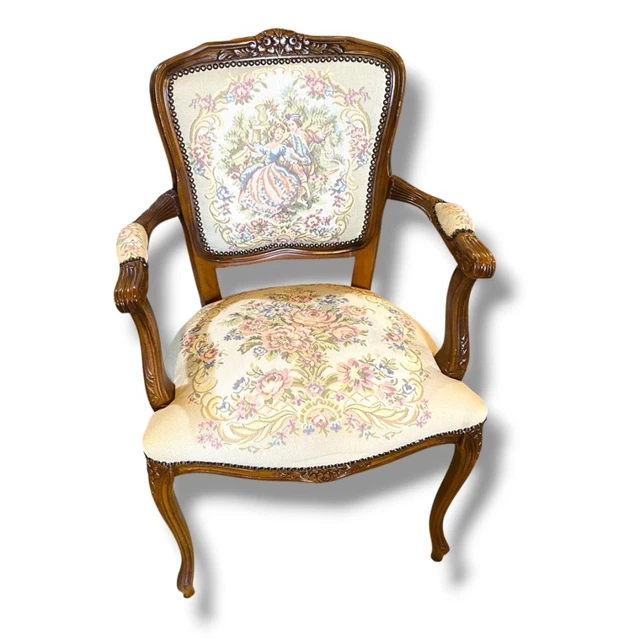
Antique Armchair
In the 18th-century French salon, the type of chair said where it belonged: flat-backed fauteuils stood in formal rows, light cabriolets were pulled up for conversation, and deep bergères with closed sides invited reading by the fire. These forms were copied through the 19th century, then reinvented in the 1920s and 1930s as the leather club chair.
1730–1940
Verified market data (US$)
$275 – $1,320 – $10,780
lowest · median · highest observed
French dealers asking on Proantic: €250–9 800 (median €1 200, 60 listings). (Proantic prices converted to USD at 1 EUR = $1.10.)
Expert tip
Look at the back: a flat back is a fauteuil à la reine, made to stand against the wall; a curved back is a cabriolet, made to be moved around. Then check the seat rails underneath for pegged joints and a stamp.
History
- Fauteuils à la reine and cabriolet chairs were developed in Paris under Louis XV, followed by straight-legged Louis XVI forms.
- The 19th century reproduced the earlier styles widely, and French leather club armchairs (fauteuils club) became popular from the 1920s.
Where it comes from
Paris for 18th-century fauteuils and bergères by guild menuisiers; provincial workshops (Provence, Lyon, Normandy) for walnut and beech country chairs; Paris again for Art Deco club armchairs.
Details to look at
- Frame carving: flowers and shells on Louis XV, fluting and rosettes on Louis XVI.
- Arm supports, legs and seat rails for breaks and repairs.
- Upholstery: old horsehair stuffing, webbing and the fabric or leather.
The market: most wanted
- Stamped Paris fauteuils and bergères in original paint or gilding.
- Pairs of Louis XVI cabriolets with fluted legs.
- 1930s French leather club chairs with original leather and springing.
Authenticity: period piece or reproduction?
- Joints are mortise-and-tenon with wooden pegs; no metal brackets.
- Old frames show multiple rows of tack holes and dark, oxidised wood underneath.
- Painted finishes show layered colours where worn.
- Warning signs: identical machine carving, new beech under artificial dirt, corner blocks screwed in, and 'club chairs' with modern foam and staple-fixed leather.
Where to buy
- Proantic, Saint-Ouen and Drouot for period fauteuils and club chairs; Leboncoin and regional brocantes for frames to re-cover.
- In the US and UK, 1stDibs, Chairish and eBay; specialist French furniture dealers for pairs.
Buyer's checklist
- Joints tight
- Pegged construction
- Upholstery state
- Pairs or single
Facts
- Typical size
- H 85–100 cm · W 55–75 cm · D 50–70 cm
- Weight
- 6–25 kg
- Period
- 1730–1940
- Materials
- Beech, walnut, oak, paint, gilt gesso, horsehair, leather or fabric
- US search interest
- 2,810 searches a month
Collector interest
Armchair draws 2,810 monthly US searches, split into 56 keyword variants.
The styles people attach to it most are art deco (280), industrial (110), french country (80), shabby chic (30).
Material searches favour leather (240), metal (110).